Los Angeles: A World in One City
Los Angeles is perhaps the most misunderstood major city in the world. Dismissed by detractors as shallow, traffic-choked, and culturally thin, LA reveals its extraordinary depths to those willing to look past the clichés — and what they find consistently astonishes them.
Los Angeles County is home to approximately 10.1 million people — more than the population of 40 individual U.S. states — making it by far the most populous county in the United States. The city itself, at 503 square miles, is the second-largest in the United States by area (after Anchorage, Alaska). Within its boundaries live people from virtually every nation on Earth, speaking over 200 languages, practicing every religion known to humanity, and bringing with them the full diversity of global culture.
This extraordinary diversity is not incidental to Los Angeles's character — it is its character. The city's neighborhoods reflect decades and centuries of immigrant communities establishing their own cultural spaces: Koreatown, the largest Korean community outside Korea; Little Tokyo, preserving Japanese-American culture through a century of adversity; Tehrangeles (Westwood and Beverly Hills), home to the largest Persian diaspora community outside Iran; Boyle Heights, the heart of Los Angeles's Mexican-American culture; Leimert Park, the creative hub of LA's African-American community. To travel through Los Angeles is to travel through the world.
Against this human backdrop stands one of the world's most striking physical settings. The Los Angeles Basin is bounded by the Santa Monica Mountains to the north, the San Gabriel Mountains to the east, the Puente Hills to the southeast, and the Pacific Ocean to the west. The combination of mountain ranges, coastal mesas, river corridors, and ocean frontage creates a landscape of perpetual drama — particularly at sunset, when the light off the Pacific turns the sky over the city into a canvas of orange, pink, and purple that seems almost too beautiful to be real.
Hollywood: The Dream Factory
Hollywood — both the neighborhood on the northern slopes of the Santa Monica Mountains and the global metaphor for the American entertainment industry — has been shaping global popular culture since the 1910s, when the young film industry relocated from New Jersey to Southern California in search of year-round sunshine and varied locations. Today, the Los Angeles metropolitan area hosts the headquarters of all six major Hollywood studios, three major television networks, hundreds of independent production companies, and the infrastructure of the world's dominant entertainment industry.
The Hollywood Walk of Fame, stretching along Hollywood Boulevard and Vine Street, features over 2,700 five-pointed terrazzo and brass stars honoring achievements in the entertainment industry. The stars are embedded in the sidewalk continuously from Gower Street to La Brea Avenue on Hollywood Boulevard and from Yucca Street to Sunset Boulevard on Vine Street. Each star is approximately 18 inches in diameter and bears the honoree's name in bronze. Receiving a star requires a formal application, a nomination fee, and the honoree's agreement to attend the star's dedication ceremony. Walking the Walk of Fame is free — a remarkable experience for film and television enthusiasts of any age.
Grauman's Chinese Theatre (now TCL Chinese Theatre), on Hollywood Boulevard, has been one of Hollywood's most recognizable landmarks since its 1927 opening. The theater's forecourt contains the famous cement blocks bearing the handprints and footprints of over 200 Hollywood celebrities — from Mary Pickford and Douglas Fairbanks (who made the first impressions in 1927) to recent inductees including Leonardo DiCaprio and Jennifer Lawrence. Inside, the theater remains an active cinema, showing films in a magnificent atmospheric interior modeled (with considerable creative license) on a Chinese imperial palace.
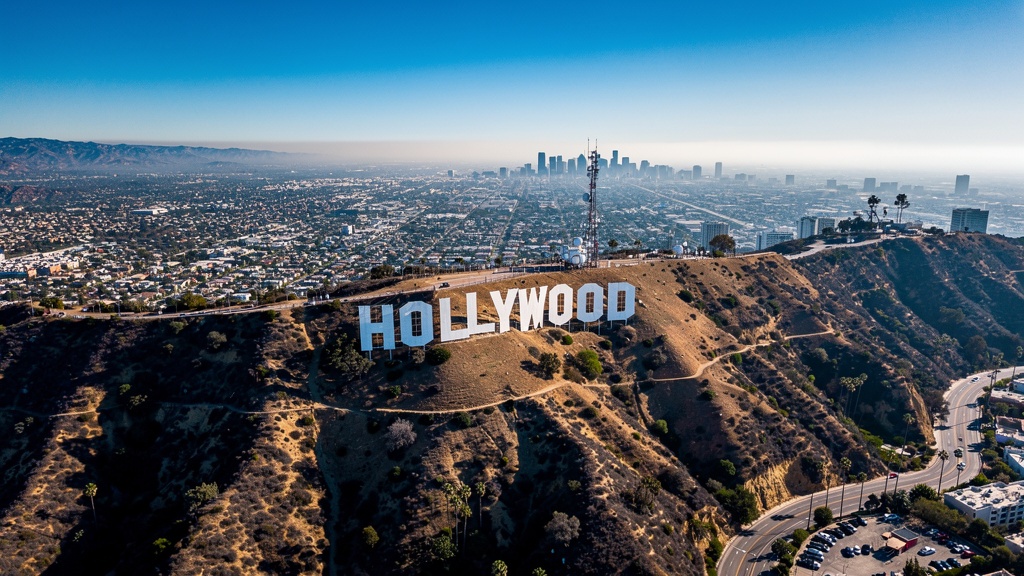
The Hollywood Sign itself — nine 45-foot-tall white letters spelling HOLLYWOOD on the south face of Mount Lee, at the eastern end of the Santa Monica Mountains — is perhaps the most universally recognized cultural symbol in the world. It was originally constructed in 1923 as an advertisement for a real estate development called "Hollywoodland" and was restored in 1978 (the letters were replaced individually by nine different celebrities, each donating $27,778) after decades of deterioration. The sign is protected by the Hollywood Sign Trust and is monitored by high-resolution cameras and motion sensors that trigger immediate alerts if anyone approaches the letters.
The best views of the Hollywood Sign are from Griffith Observatory (approximately 1 mile due east of the sign), from the Hollywood Bowl overlook, from Lake Hollywood Park (which offers an unusually close and direct view), and from the Mulholland Drive scenic overlook. Hiking to the sign itself is possible via several trails from Beachwood Canyon and Griffith Park, though the final approach is fenced off and you can only get within about 100 feet of the letters.
Beverly Hills, Bel Air & the West Side
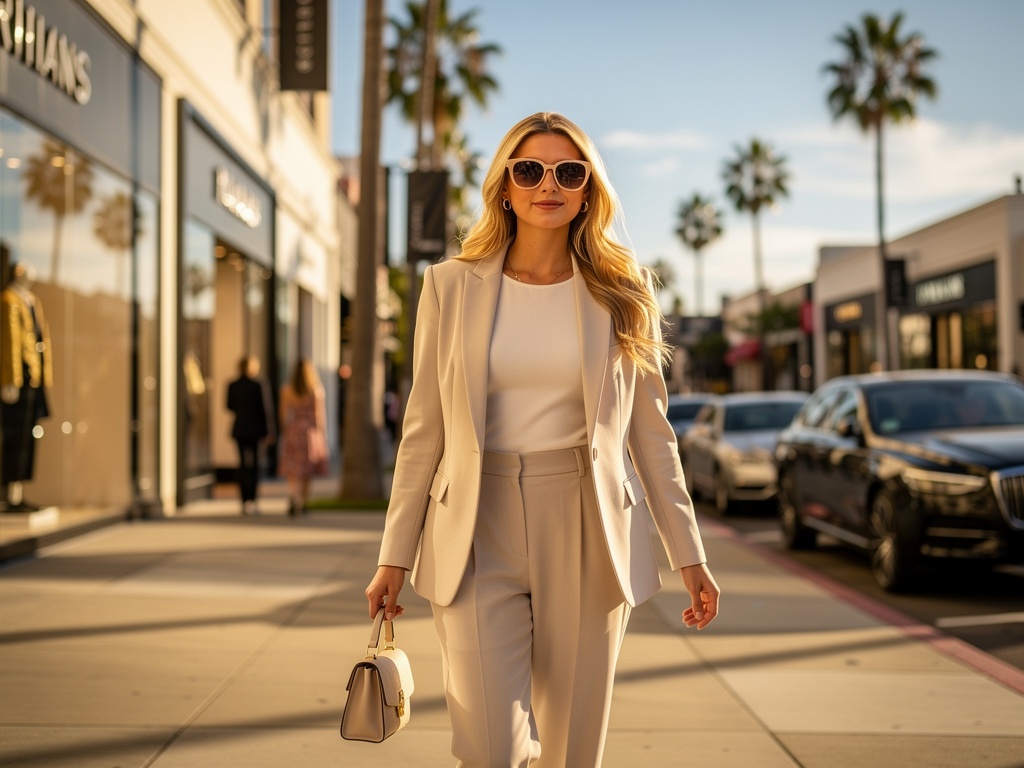
Beverly Hills — incorporated as an independent city completely surrounded by Los Angeles — is the international symbol of American luxury and wealth. With a permanent population of only 34,000 but some of the highest property values in the United States (median home prices exceed $3 million), Beverly Hills is simultaneously a functioning residential community, a world-class shopping destination, and a major tourist attraction.
Rodeo Drive, the famous three-block stretch from Wilshire Boulevard to Santa Monica Boulevard, is lined with boutiques of every major luxury fashion house on Earth: Chanel, Gucci, Louis Vuitton, Cartier, Bulgari, Hermès, and dozens more. The street is immaculately maintained, with flowering trees lining the sidewalks and the distinctive two-story Rodeo Drive cobblestone plaza at the southern end providing photo opportunities for the millions of visitors who come here annually — most without making any purchases.
Adjacent Bel Air and Holmby Hills are where the Hollywood elite have lived since the 1920s, their estates concealed behind hedges and gates along winding roads through the chaparral-covered hills. The Bel-Air hotel — a former residence converted into a 103-room resort in 1946, set among 12 acres of gardens with a resident flock of swans — is one of the most romantic places to stay anywhere in California.
The Beverly Hills Hotel — the "Pink Palace" on Sunset Boulevard — has been welcoming Hollywood royalty since 1912 and remains one of the most iconic lodgings in the world. Its distinctive pink-and-green color scheme, the bungalows where Marilyn Monroe, Elizabeth Taylor, and Frank Sinatra lived for extended periods, and the Polo Lounge restaurant (still one of LA's prime power lunch venues) make it a landmark as much as a hotel.
West Hollywood, immediately east of Beverly Hills, is the creative heart of the LA gay community and home to the legendary Sunset Strip — the stretch of Sunset Boulevard between Crescent Heights and Doheny Drive that hosted the rock and roll revolution of the 1960s–80s. The Troubadour (where Elton John made his American debut in 1970), the Whisky a Go Go (birthplace of the go-go dancer), and The Roxy (where Bruce Springsteen played his first LA show) are still active music venues. Chateau Marmont, a 1920s Norman Gothic château perched above the Strip, has been the preferred Hollywood hideaway for a century of celebrities and remains one of LA's most atmospheric hotel experiences.
Santa Monica & Venice Beach
Santa Monica is the idealized California beach city — clean, walkable, prosperous, and set against a Pacific backdrop of exceptional beauty. Incorporated as an independent city in 1886 but now completely surrounded by Los Angeles, Santa Monica is one of the most desirable places to live on the West Coast and consistently ranks among the most livable cities in California.
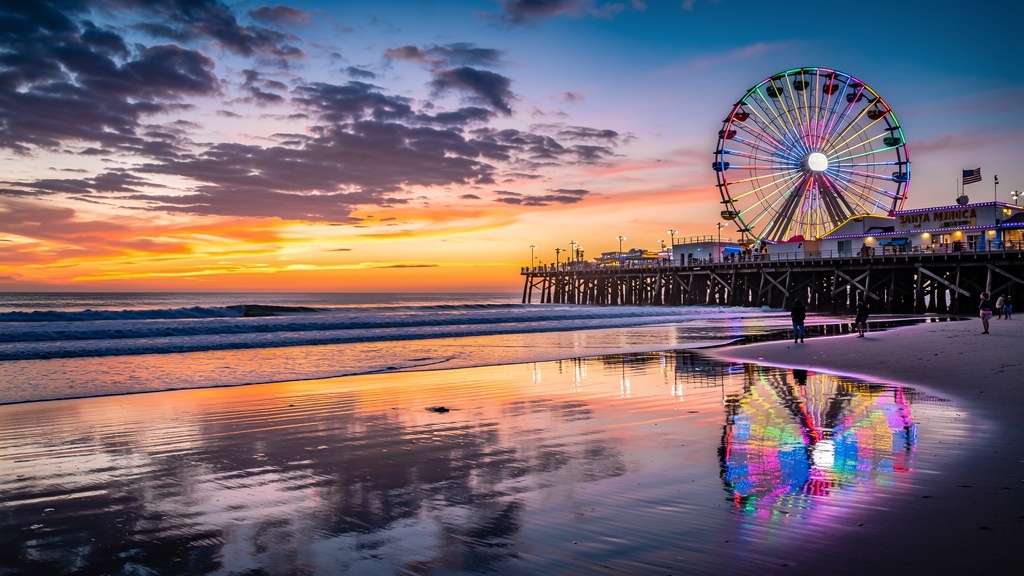
The Santa Monica Pier, extending 1,600 feet into the Pacific Ocean, is the western terminus of Historic Route 66 and one of the most photographed locations in California. Pacific Park amusement park on the pier, with its solar-powered Ferris wheel (the world's first solar-powered Ferris wheel), roller coaster, and carnival games, has been entertaining visitors since 1996. The pier's Aquarium, operated by Heal the Bay, provides free ocean education and touch tanks, including displays of local marine life. At the foot of the pier, the Carousel Building — housing one of the original 1922 carousel horses — is one of the rare surviving examples of an early-20th-century seaside carousel on the West Coast.
Santa Monica State Beach, stretching three miles north and south of the pier, is one of the finest urban beaches in California — wide, clean, regularly groomed, and backed by the gorgeous Santa Monica Mountains. The beach is equipped with volleyball courts, playgrounds, and restroom facilities, and is patrolled by lifeguards year-round. The parallel Ocean Front Walk, running along the top of the beach, is a popular cycling and walking route connecting Santa Monica to Venice Beach to the south.
Venice Beach, a short walk or bike ride south of Santa Monica, is one of the most singular places in California — an outdoor theater of human exuberance and eccentricity that has been drawing bohemians, bodybuilders, artists, and street performers for over a century. The Venice Boardwalk (actually a concrete promenade) is lined with souvenir vendors, street artists, fortune tellers, and musicians. Muscle Beach Venice, an outdoor weight training facility at the south end of the boardwalk, has been the training ground for bodybuilding legends including Arnold Schwarzenegger and Lou Ferrigno since the 1950s. The Venice Canals, hidden one block from the boardwalk, are a charming and almost universally unknown pocket of the city — 2.5 miles of narrow waterways lined with cottage-style homes, accessible via a small number of public paths and footbridges.
Griffith Observatory & Griffith Park
Griffith Observatory, perching on the south-facing slope of Mount Hollywood in Griffith Park at an elevation of 1,134 feet, is one of Los Angeles's most beloved institutions and one of the finest public observatories in the United States. Built in 1935 and funded by a bequest from mining mogul Griffith J. Griffith, who famously declared that "every person in Los Angeles should be able to look through that telescope for free," the observatory has fulfilled that democratic mandate for 90 years, offering free admission to its planetarium shows and outdoor telescopes.
The observatory's Art Deco building — three copper domes rising above a white cement structure that appears almost to float above the city — is one of LA's most architecturally distinctive landmarks and one of the most filmed buildings in cinema history. James Dean's famous knife fight in Rebel Without a Cause (1955) was filmed here, as were scenes from Terminator (1984), The Rocketeer (1991), and La La Land (2016). The 360-degree view from the observatory's terraces — encompassing the Hollywood Sign, the Los Angeles Basin, the Pacific Ocean, and on clear days, the islands of Santa Catalina and San Clemente — is among the finest urban panoramas in North America.
Griffith Park, at 4,210 acres one of the largest urban parks in the United States, extends from the observatory north through the Santa Monica Mountains to the Burbank border. Within its boundaries are two golf courses, the LA Zoo and Botanical Gardens, the Autry Museum of the American West, multiple equestrian centers, and over 53 miles of hiking trails. The popular Ferndell Nature Museum trail, a lush arroyo through native ferns and woodland, offers a startling contrast to the surrounding urban landscape. Travel Town, a free outdoor railroad museum with vintage locomotives and cars accessible to children, is one of LA's most delightful family destinations.
Los Angeles's World-Class Museums
Los Angeles is home to a remarkably dense collection of world-class cultural institutions — a reflection of the wealth generated by the entertainment industry and the philanthropic traditions of the city's cultural elite. The range of museums available to LA visitors, and the quality of their collections, rivals any city in North America.
The Getty Center (free admission, parking charged) is one of the great art museums of the world, housed in a stunning 1997 Richard Meier building on a hilltop in Brentwood with panoramic views of the city and the ocean. The Getty's collection — assembled with the extraordinary resources of the J. Paul Getty Trust, the world's wealthiest arts foundation — includes paintings, drawings, manuscripts, sculpture, decorative arts, and photography of the very highest caliber. The 16th-century Dutch and Flemish paintings, the French decorative arts of the Ancien Régime, and the photography collection are particularly outstanding. The gardens, designed by Robert Irwin, are among the finest horticultural installations in California.
LACMA (Los Angeles County Museum of Art), on Wilshire Boulevard's "Museum Row," is the largest art museum in the western United States, with a collection of over 150,000 works spanning 6,000 years of human creativity. Chris Burden's Urban Light installation — 202 restored antique street lamps arranged in a colonnade on the museum's front forecourt — has become one of LA's most iconic public art works, photographed millions of times. The museum's holdings of pre-Columbian art, ancient Mediterranean artifacts, and Asian art are world-class; recent expansions have strengthened its contemporary and African collections.
The Museum of Contemporary Art (MOCA) has three locations in LA (MOCA Grand, the Geffen Contemporary, and the Pacific Design Center), collectively holding one of the finest collections of post-1940 art anywhere in the world. The Geffen Contemporary, a former warehouse in Little Tokyo converted by Frank Gehry, is one of the most dramatically inventive museum spaces in California. MOCA's strength in Abstract Expressionism, Pop Art, Minimalism, and contemporary international art makes it essential for serious art lovers.
The Natural History Museum of LA County, in Exposition Park adjacent to USC, holds 35 million specimens and artifacts in the largest natural and historical museum in the western United States. The dinosaur hall — reorganized in 2011 into a spectacular open-floor environment that allows visitors to view scientists working on specimens in real time — is one of the finest in the country. The museum's North American mammal halls and its extraordinary collection of gemstones and minerals round out a remarkable visitor experience.
Los Angeles: One of the World's Great Food Cities
Los Angeles has quietly become one of the great food cities of the world — a development that has surprised even many longtime residents, who grew up in a food culture that was good but rarely transcendent. The transformation has been driven by the extraordinary diversity of the city's population (making authentic ethnic cuisines from across the world available in a concentration unmatched outside of global metropolises), a year-round growing season that provides chefs with the finest produce in the country, and the arrival of a generation of talented chefs who have chosen LA over New York or San Francisco as the place to do their most ambitious work.
Los Angeles's ethnic restaurant scene is the city's greatest culinary asset. The breadth and authenticity of what's available is simply staggering: Michelin-starred omakase sushi in Little Tokyo; hand-pulled Lanzhou beef noodles in the San Gabriel Valley (the largest concentration of authentic Chinese regional cuisines outside China); exceptional Persian food in Westwood; world-class Korean barbecue in Koreatown (superior, many argue, to anything available in Seoul); extraordinary Mexican regional cooking in Boyle Heights and East LA; and Vietnamese pho and bánh mì along the Westminster and Garden Grove corridors in Orange County (technically outside LA but intimately connected to it).
LA's taco culture deserves special recognition. The city's taco scene — encompassing everything from the simple perfection of a carne asada taco from a Boyle Heights street cart to the elaborate "California taco" at an upscale Culver City restaurant — is arguably the finest in the United States, rivaling what you'll find in Mexico City itself. Jonathan Gold, the LA food critic who became the first restaurant reviewer ever awarded the Pulitzer Prize for Criticism, spent his career arguing that Los Angeles's greatest cultural achievement was its taco culture, and it's difficult to disagree.
For visitors seeking an overview of LA's food culture in a single afternoon, the Original Farmers Market at 3rd and Fairfax — established in 1934 and still operating in its original outdoor space — provides an ideal introduction. The market's 100+ stalls and restaurants span everything from Brazilian churrasco to French crêpes to Korean bibimbap to Cajun gumbo, and the surrounding Grove outdoor mall (love it or hate it for its Main Street USA aesthetic) provides excellent people-watching and retail therapy.
Exploring Los Angeles's Distinct Neighborhoods
Los Angeles is not one city but a constellation of distinct communities, each with its own character, cuisine, and cultural life. Understanding the city's neighborhood structure is the key to navigating it effectively — and the key to having an exceptional experience rather than a generic tourist one.
Downtown LA (DTLA) has undergone a dramatic renaissance in the past two decades, transforming from a moribund office district into a vibrant urban neighborhood. The Arts District, in the former industrial zone east of the 101 freeway, is home to the most exciting concentration of galleries, restaurants, and boutique hotels in the city. The Historic Core preserves spectacular examples of early-20th-century commercial architecture — the Bradbury Building (1893), with its extraordinary Victorian atrium, is one of the most filmed buildings in LA and is genuinely among the finest interior spaces in California. Grand Central Market, a public market operating continuously since 1917, has been reinvented as a showcase for LA's best food vendors.
Silver Lake and Los Feliz, east of Hollywood and north of downtown, are the city's most self-consciously creative neighborhoods — home to artists, musicians, designers, and the literary community that makes LA culturally richer than its reputation suggests. Sunset Junction, at the intersection of Sunset and Santa Monica Boulevards in Silver Lake, is the neighborhood's social hub, surrounded by independent bookshops, vintage clothing stores, coffee roasters, and bars that could hold their own in any major international city.
Culver City, between downtown and Santa Monica, has emerged as one of LA's most interesting mid-city destinations. The Museum of Jurassic Technology (one of the most singular and stimulating museum experiences in the world — essentially an anti-museum that interrogates the nature of knowledge and display), excellent contemporary galleries, and a restaurant scene of growing sophistication make this a neighborhood worth seeking out.
Getting Around Los Angeles
Los Angeles has a reputation as the ultimate car city — a reputation not entirely undeserved but increasingly outdated. The city has invested billions of dollars in public transit infrastructure over the past decade, and its Metro rail system, while still expanding, now provides useful connections between many major attractions.
The Metro Expo Line connects downtown LA to Santa Monica in 46 minutes, passing through the University of Southern California, Expo Park, Culver City, and West LA. The Metro Red/Purple Line subway connects downtown to Hollywood, Koreatown, and the Westside. The Metro Gold Line extends from downtown east to Pasadena (useful for Caltech visits) and west to East LA. For visitors staying in Santa Monica or West Hollywood, the Big Blue Bus (Santa Monica's municipal transit) provides excellent coverage of the Westside.
For those who choose to drive, traffic is genuinely challenging but manageable with the right strategies. Avoid the 405 and 101 freeways during rush hours (7–10 AM and 4–7 PM on weekdays). The surface streets — Sunset Boulevard, Melrose Avenue, Olympic Boulevard — are often faster than freeways during peak hours and significantly more interesting. Use Google Maps or Waze for real-time traffic routing; both work exceptionally well in LA. Parking is generally available in the neighborhoods but paid parking lots are often necessary in Santa Monica, Hollywood, and West Hollywood.
🚇 LA Transit Quick Reference
- Metro App: TAP card for all Metro rail and bus lines — load at machines at any rail station
- Day Pass: $7 for unlimited Metro rides — excellent value if using transit more than 3 times
- Airport: LAX FlyAway bus ($9.75) connects to Union Station; Metro connection from Sepulveda station
- Rideshare: Uber and Lyft are widely used; particularly useful for late night journeys beyond Metro hours
- Cycling: Santa Monica and Venice Beach are highly bikeable; Metro Bike Share available at many stations
Practical Visitor Information for Los Angeles
🌅 Best Times to Visit
Los Angeles enjoys an excellent climate year-round, but the best months for visitors are March–May (wildflowers, moderate temperatures, clear skies) and September–November (warmest ocean temperatures, lower humidity, clearest days). June–August brings "June Gloom" to the coastal areas — persistent morning overcast that often burns off by afternoon. Inland areas are significantly hotter in summer (100°F+); coastal areas remain temperate. December through February is the rainy season but brings spectacular clarity after storms.
🏨 Where to Stay
Santa Monica and Venice offer the best combination of beach access, walkability, and good restaurants for visitors. West Hollywood provides proximity to Sunset Strip nightlife and Beverly Hills shopping. Hollywood is convenient for major attractions but has uneven neighborhood quality. Downtown LA (Arts District or Grand Central Market area) offers the most vibrant urban experience and good Metro connections. Mid-Wilshire provides a central location between the Westside and Downtown. Malibu offers spectacular Pacific views but requires a car for all activities.
☀️ Sun Protection
Los Angeles receives approximately 284 sunny days per year, and the California sun is intense year-round. High SPF sunscreen, UV-blocking sunglasses, and hats are essential — particularly when spending time at beaches, hiking in the hills, or attending outdoor events. The UV index in LA regularly reaches 10–11 (extreme) from April through October. The altitude of Griffith Park, the Hollywood Hills, and Santa Monica Mountains intensifies UV exposure further.
🎪 Major Annual Events
The Los Angeles County Fair (September–October, Pomona) is the largest county fair in the US. Coachella Valley Music and Arts Festival (April, Indio — 2 hours from LA) is the world's most famous music festival. LA Pride (June, West Hollywood) is one of the largest Pride events in the United States. The Tournament of Roses Parade (January 1, Pasadena) precedes the Rose Bowl game. The Academy Awards (March, Dolby Theatre Hollywood) draws the world's attention to LA every spring.