California: The Academic Capital of the World
No region on Earth can match California's concentration of world-class universities. In a single state, you will find more Nobel laureates, Fields Medalists, Pulitzer Prize winners, and Fortune 500 CEOs than most countries can claim in their entirety.
California's academic excellence is not an accident. It is the result of visionary public investment that began in the mid-19th century, a culture that has always valued innovation and merit over tradition and pedigree, and the demographic richness of a state that draws talent from every corner of the world. The University of California system — established by the state constitution in 1868 — has become the largest and arguably the finest public university system in the United States, with ten campuses serving over 280,000 students. Alongside the UC system, California is home to private universities of the first rank: Stanford, Caltech, and USC among them.
The economic impact of California's universities is staggering. Stanford University alone has been credited by researchers with helping create 5.4 million jobs and generating over $2.7 trillion in annual economic output through the companies its faculty and alumni have founded — including Google, HP, Yahoo, Nike, WhatsApp, and Snapchat. The University of California system contributes an estimated $67.3 billion annually to California's economy. These numbers underscore how deeply California's universities are woven into the fabric of the global economy, not just the state's academic reputation.
For international visitors, California's universities offer unique opportunities. Most campuses welcome visitors and offer free self-guided tours, campus maps, and visitor centers. Many of the most architecturally magnificent campuses — Stanford's Spanish Colonial Revival, UC Berkeley's Beaux-Arts buildings, UCLA's Romanesque revival — are genuinely worth visiting as architectural and cultural destinations in their own right, entirely apart from any academic interest.
Stanford University: The Heartbeat of Silicon Valley

Stanford University, founded in 1885 by railroad magnate Leland Stanford and his wife Jane as a memorial to their son, has become one of the most consequential institutions of higher learning in the history of civilization. Its 8,180-acre campus in Palo Alto — the largest in the United States — sprawls across the foothills of the Santa Cruz Mountains south of San Francisco Bay, a landscape of extraordinary beauty that provides a fitting backdrop for extraordinary intellectual work.
Stanford's consistent ranking among the top three universities in the world (alongside MIT and Harvard) reflects its extraordinary breadth of excellence: its School of Engineering, School of Medicine, Law School, Business School, and departments of physics, chemistry, biology, computer science, and economics are all ranked among the finest in the world. The university has been awarded 83 Nobel Prizes and 30 MacArthur Fellows and holds the record for the highest number of patents granted among American universities.
The university's symbiotic relationship with Silicon Valley — many argue that Stanford effectively created Silicon Valley through its policies of encouraging technology commercialization and faculty entrepreneurship — gives it a unique character among elite research universities. The culture of application, of turning theoretical knowledge into practical innovation, runs deeply through Stanford's DNA.
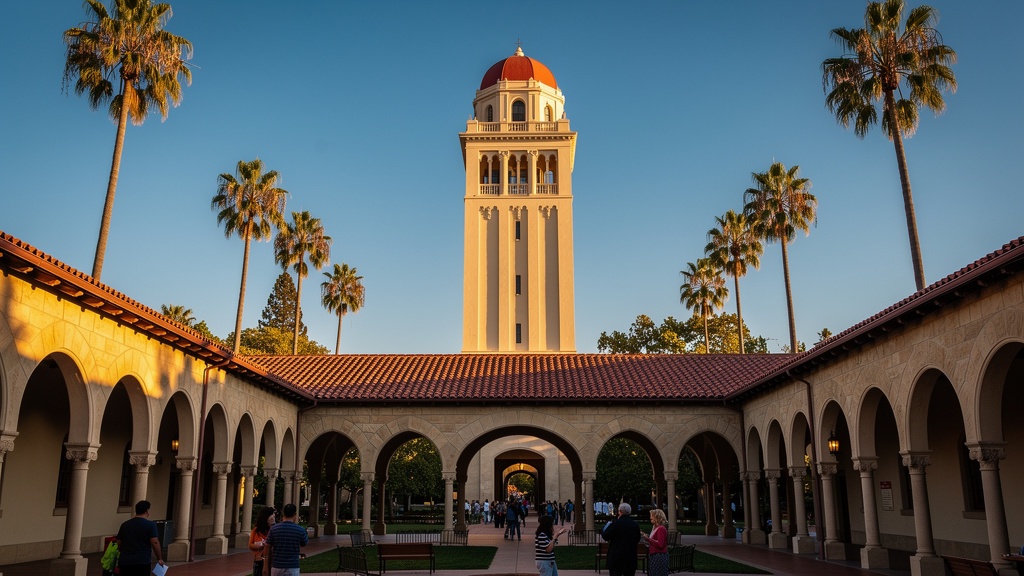
The heart of Stanford's campus is the Main Quad — a magnificent courtyard surrounded by arcaded sandstone buildings with red-tile roofs in the Richardsonian Romanesque and Mission Revival styles, completed in 1906. The Memorial Church at its center, reconstructed after the 1906 earthquake destroyed the original, is one of the finest examples of Byzantine-influenced religious architecture in California, featuring stunning mosaics and stained glass. The Hoover Tower, a 285-foot Art Deco landmark visible for miles, houses the Hoover Institution on War, Revolution and Peace — one of America's most prominent think tanks.
Stanford's d.school (the Hasso Plattner Institute of Design) has become one of the most influential teaching laboratories in the world, propagating the design thinking methodology — an approach to creative problem-solving that has been adopted by companies and organizations globally. Stanford Medicine is consistently ranked among the top three medical schools in the United States. The SLAC National Accelerator Laboratory, managed by Stanford for the U.S. Department of Energy, is a world-leading facility for X-ray science and particle physics research.
For visitors, Stanford offers a remarkable campus to explore. The Cantor Arts Center, housing an exceptional collection of Rodin sculptures in an outdoor garden (the largest collection outside Paris), admission-free galleries, and a beautiful building by the landscape architect Hideo Sasaki, is one of the finest university art museums in the country. The Stanford dish — a massive 150-foot radio telescope standing in the foothills above the campus — is the center of a popular hiking trail offering panoramic views of the Bay Area.
| Quick Facts | Stanford University |
|---|---|
| Founded | 1885 (opened 1891) |
| Location | Stanford/Palo Alto, Santa Clara County |
| Campus Size | 8,180 acres (largest in the US) |
| Undergraduate Enrollment | ~7,300 |
| Graduate & Professional Enrollment | ~10,800 |
| Acceptance Rate | ~3.7% (Class of 2027) |
| Nobel Laureates | 83 (affiliated) |
| Endowment | $36.8 billion (2024) |
University of California, Berkeley: The Public Ivy
The University of California, Berkeley is the founding campus of the University of California system and is widely considered the finest public university in the world. Its 1,232-acre campus in the city of Berkeley, on the east shore of San Francisco Bay, has been at the center of American intellectual, political, and cultural life for over 150 years — contributing not merely to the advancement of knowledge but to the advancement of society itself.
Berkeley's academic credentials are extraordinary. The university has produced more Nobel laureates than any institution except MIT, Harvard, and Chicago (and more than most countries): 32 faculty members currently hold Nobel Prizes. Twelve Fields Medal winners have been affiliated with Berkeley. The university's physics, chemistry, biochemistry, computer science, engineering, public health, and law schools are all consistently ranked among the very best in the world. UC Berkeley has been awarded more grant funding from the National Science Foundation than any other American university.
Berkeley's contribution to science includes achievements that have profoundly shaped modern civilization. The Manhattan Project conducted critical research here during World War II. Glenn Seaborg discovered 10 transuranic elements on this campus. The first practical cyclotron was built here by Ernest Lawrence. The development of UNIX operating system components, the BSD operating system, and fundamental protocols of the internet occurred here. In the life sciences, Berkeley's biologists have contributed foundational discoveries in genetics, molecular biology, and neuroscience that have saved millions of lives.
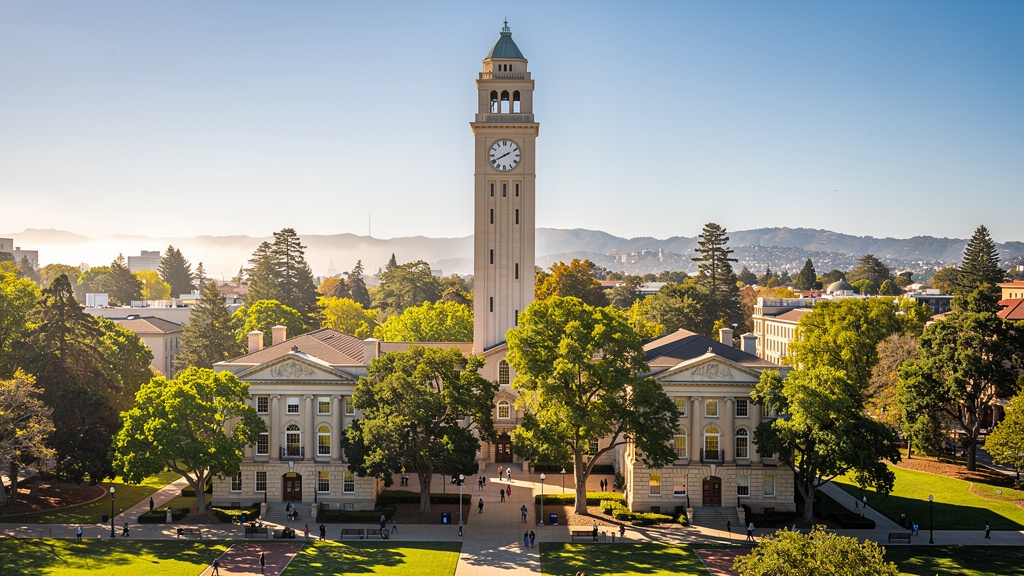
The campus itself is architecturally magnificent. The Beaux-Arts buildings of the central campus — Doe Memorial Library, Wheeler Hall, Durant Hall, and the iconic Sather Gate — were designed in the early 20th century and constitute one of the finest collections of American Beaux-Arts architecture on the West Coast. The 307-foot Sather Tower (the Campanile), modeled on the campanile in Venice's St. Mark's Square, offers panoramic views across the Bay Area from its observation deck and rings out the quarter-hours with carillon bells that have become as much a part of Berkeley's identity as the protests and intellectual ferment for which the campus is equally famous.
Berkeley's history of student activism is inseparable from its identity. The Free Speech Movement of 1964 — sparked when campus authorities tried to prevent students from distributing political literature at Sproul Plaza — is often cited as the opening shot of the American student protest movements of the 1960s. The anti-Vietnam War movement had some of its most dramatic moments on this campus. The environmental movement, the anti-nuclear movement, and the disability rights movement all have deep roots at Berkeley. This tradition of engaged citizenship — of the belief that scholarship carries a responsibility to the world beyond the campus gates — remains a defining characteristic of Berkeley's culture.
| Quick Facts | UC Berkeley |
|---|---|
| Founded | 1868 |
| Location | Berkeley, Alameda County |
| Campus Size | 1,232 acres |
| Undergraduate Enrollment | ~32,700 |
| Graduate Enrollment | ~13,000 |
| Acceptance Rate | ~11.4% (California residents) |
| Nobel Laureates | 107 (affiliated) |
| Endowment | $7.8 billion (2024) |
UCLA: Excellence in the City of Angels
The University of California, Los Angeles, founded in 1919 as the second campus of the UC system, has grown into one of the great research universities of the world — and perhaps the most comprehensive one. UCLA offers more undergraduate major programs, more graduate degree programs, and more academic disciplines than virtually any other university in the United States, and it does so at a level of quality that places it consistently in the top 15 universities globally.
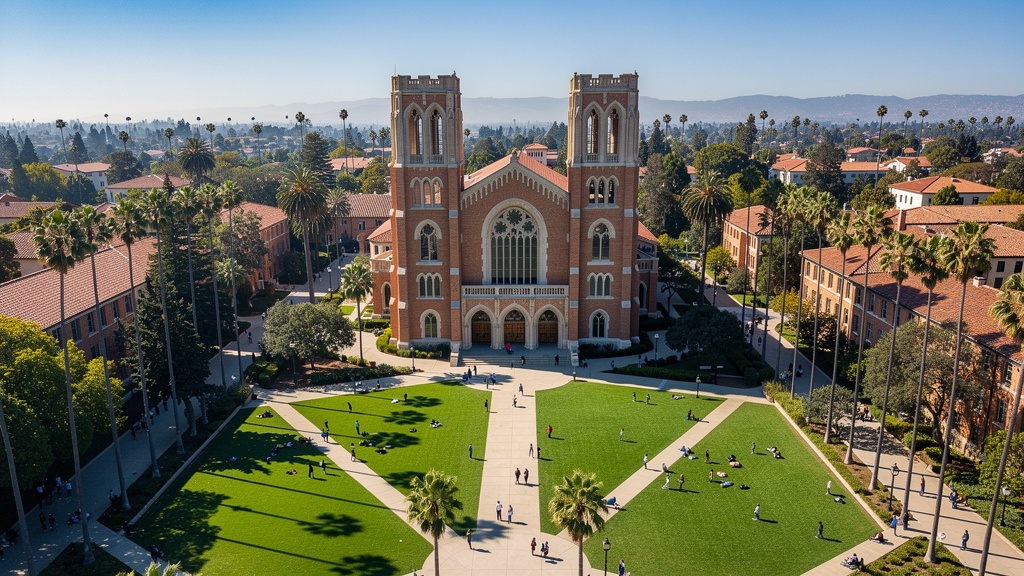
UCLA's location in the Westwood neighborhood of Los Angeles — bordered by Beverly Hills to the east, Bel-Air to the north, and Santa Monica to the west — gives it a physical setting matched by few urban universities. The 419-acre campus is a UNESCO World Heritage candidate for its collection of Romanesque Revival architecture, centering on the iconic Powell Library and Royce Hall, both completed in 1929. The campus's tree-lined walkways, fountain courtyards, and sweeping lawns create an oasis of calm within one of the world's most dynamic cities.
UCLA's medical school and health sciences programs are its most celebrated: the David Geffen School of Medicine consistently ranks among the top five in the country for research, and the UCLA Health system is the most comprehensive academic medical center on the West Coast. The university has produced Nobel laureates in medicine and physiology, chemistry, physics, and economics. Its School of Law, Anderson School of Management, and Luskin School of Public Affairs are all among the top programs in their respective fields nationally.
UCLA's athletic program, the Bruins, has won 118 NCAA championships — the most in college sports history. The 1970s UCLA basketball dynasty, coached by John Wooden, produced ten national championships in 12 years, the greatest sustained dominance in American college sports history. The university's Olympic tradition is equally impressive: 260 former UCLA student-athletes have competed in the Olympics, winning 284 medals. This athletic excellence reflects the broader UCLA culture of competitive excellence that permeates academic and research activities as well.
The university's position in the Los Angeles cultural ecosystem creates unique opportunities for its students and visitors. UCLA's Hammer Museum (free admission) is one of LA's finest art museums. The UCLA Film and Television Archive is the second-largest audiovisual archive in the world after the Library of Congress. The Fowler Museum of Cultural History holds outstanding collections of African, Pacific, pre-Columbian American, and Native North American material culture. Visiting academics and artists from the entertainment, fashion, and creative industries augment the formal curriculum in ways that no other campus in the country can match.
| Quick Facts | UCLA |
|---|---|
| Founded | 1919 |
| Location | Westwood, Los Angeles |
| Campus Size | 419 acres |
| Undergraduate Enrollment | ~32,800 |
| Graduate Enrollment | ~14,400 |
| Acceptance Rate | ~8.8% (CA residents) |
| Nobel Laureates | 17 (faculty) |
| Endowment | $6.1 billion (2024) |
California Institute of Technology: Where Genius Gathers
The California Institute of Technology, universally known as Caltech, is perhaps the most extraordinary university in the world for what it achieves relative to its size. With fewer than 2,300 students — a figure roughly equivalent to a modest high school — Caltech has produced 45 Nobel Laureates, including 24 faculty members who received their Nobel Prizes while at Caltech. It is consistently ranked as the world's number-one university for science and technology in global rankings, ahead of MIT, Stanford, and Oxford.
Founded in 1891 in Pasadena, California — in the shadow of the San Gabriel Mountains northeast of Los Angeles — Caltech's mission has always been to produce the leaders of science and technology. The institute's eight schools cover the full range of natural sciences and engineering, and the depth of research taking place within them is breathtaking. Caltech operates CERN's detector systems, manages NASA's Jet Propulsion Laboratory, runs the Laser Interferometer Gravitational-Wave Observatory that detected gravitational waves for the first time in 2015 (a discovery that earned the 2017 Nobel Prize in Physics), and participates in virtually every major astronomical discovery of the 21st century through its close relationship with the Palomar and Keck Observatories.
The JPL connection is Caltech's most publicly visible achievement: nearly every Mars mission in American history has been designed, built, and managed by JPL under Caltech's supervision. Curiosity, Perseverance, Ingenuity, Pathfinder, Spirit, Opportunity — these iconic names represent Caltech-JPL achievements that have expanded human understanding of our solar system. The JPL visitor center in La Cañada Flintridge (accessible from the Caltech campus) offers public tours by reservation and is a must-visit for anyone interested in space exploration.
Caltech's culture is notoriously intense — the academic demands on its undergraduates are, by most accounts, the most rigorous of any American university — but it is also famously playful. The institute's prank culture, known as "hacking," has produced legendary escapades including the famously elaborate prank played on MIT's tech community and the annual Campus Ditch Day tradition. This combination of rigorous intellectual seriousness and irreverent creativity feels distinctly Californian.
| Quick Facts | Caltech |
|---|---|
| Founded | 1891 |
| Location | Pasadena, Los Angeles County |
| Campus Size | 124 acres |
| Total Enrollment | ~2,280 |
| Faculty-to-Student Ratio | 1:3 |
| Acceptance Rate | ~2.8% |
| Nobel Laureates | 45 (alumni and faculty) |
| Endowment | $4.5 billion (2024) |
University of Southern California: The Trojan Spirit
The University of Southern California, founded in 1880 as the first private research university in the American West, is among the most comprehensive private universities in the United States. With over 47,000 students studying across schools of law, business, engineering, cinema, medicine, architecture, music, and more, USC's breadth of academic offering is matched by few institutions of any type.
USC's Film School — the USC School of Cinematic Arts — is widely considered the finest film school in the world. Its alumni list reads like a history of American cinema: George Lucas (Star Wars, American Graffiti), Ron Howard (Apollo 13, A Beautiful Mind), Robert Zemeckis (Forrest Gump, Back to the Future), and dozens of other directors, producers, and industry leaders who have shaped the global entertainment industry over the past 70 years. The school's facilities are extraordinary: multiple professional-grade sound stages, editing suites, and production facilities that support student filmmaking at a level of quality unmatched anywhere.
USC's main campus in University Park, adjacent to downtown Los Angeles, is a beautiful space of Italianate and Spanish Colonial Revival architecture set around a central park. The campus's central mall, lined with Doheny Library (a spectacular Baroque Revival building housing the university's general collection) and iconic academic buildings, has been used as a film and television location hundreds of times — most famously in Forrest Gump, which used the campus extensively as Harvard. The new Health Sciences Campus, located in East LA, houses USC's medical school and one of the largest hospital systems in Southern California.
UC San Francisco: The World's Medical Research Hub
The University of California, San Francisco, is unique among the UC campuses in that it is entirely devoted to health sciences — medicine, nursing, pharmacy, dentistry, and the biological sciences that underpin medical research. It has no undergraduates, no football team, and no traditional campus life. What it does have is arguably the finest concentration of medical research talent in the United States, and a track record of discoveries that have saved millions of lives around the world.
UCSF's research achievements include some of the most important medical discoveries of the 20th century. The development of human insulin through recombinant DNA technology — the foundational discovery of the modern biotechnology industry — occurred at UCSF. Researchers here discovered the prion proteins responsible for Creutzfeldt-Jakob disease and mad cow disease (a discovery that earned the 1997 Nobel Prize in Physiology or Medicine for UCSF's Stanley Prusiner). UCSF has been at the forefront of HIV/AIDS research since the epidemic began, and its researchers have made fundamental contributions to understanding COVID-19.
UCSF's main campus is spread across multiple sites in San Francisco — the Mission Bay campus (a modern biomedical research hub built on a former industrial waterfront), the Parnassus Heights campus (overlooking Twin Peaks and the Pacific), and the Mount Zion campus in the Western Addition. Together, these sites constitute one of the world's most productive biomedical research communities, annually producing thousands of peer-reviewed publications and attracting over $1.5 billion in research grants — more than any other public institution in the United States.
UC San Diego: Oceanside Research Excellence
The University of California, San Diego, founded in 1960 on 2,141 acres of coastal bluffs overlooking the Pacific Ocean in La Jolla, is one of the fastest-rising universities in the world. In the 60+ years since its founding, UCSD has climbed from obscurity to consistent placement in the top 15 universities globally — an ascent driven by exceptional research output, strategic faculty recruitment, and the natural advantages of its extraordinary location.
UCSD's strengths are concentrated in the natural sciences, engineering, and medicine. The Scripps Institution of Oceanography — one of the oldest and most important ocean research institutions in the world, incorporated into UCSD in 1912 — gives the university unmatched depth in ocean science, climate research, and marine biology. The Salk Institute for Biological Studies, located adjacent to the campus and closely affiliated with it, is one of the world's leading centers for basic biological research, housed in one of the most extraordinary pieces of architecture in California — Louis Kahn's 1965 brutalist masterwork of travertine stone overlooking the Pacific.
UCSD's location in La Jolla — one of California's wealthiest and most beautiful neighborhoods, facing a coastline of exceptional beauty with the Torrey Pines State Natural Reserve to the north — gives it a campus environment unlike any other research university in the world. Students can surf or kayak within minutes of their laboratories, and the intellectual community around the campus has attracted a remarkable concentration of biotechnology and pharmaceutical companies that interact closely with the university's research enterprise.
| Quick Facts | UC San Diego |
|---|---|
| Founded | 1960 |
| Location | La Jolla, San Diego County |
| Campus Size | 2,141 acres |
| Undergraduate Enrollment | ~33,500 |
| Nobel Laureates | 27 (affiliated) |
| Acceptance Rate | ~24% |
The University of California System: A Public Good Unlike Any Other
The University of California system is one of the most remarkable achievements in the history of public education. Established by the California Constitution in 1868 with the specific mandate to provide "the highest grade of education" as a right of Californians regardless of social class or financial means, the UC system has grown to encompass ten campuses serving over 280,000 students, with an annual research budget exceeding $8 billion.
The ten UC campuses — Berkeley (1868), UCLA (1919), Santa Barbara (1944), Davis (1905), San Diego (1960), Irvine (1965), Santa Cruz (1965), Riverside (1954), Merced (2005), and the health sciences-only San Francisco (1864) — collectively represent the world's greatest public university system. Each campus has developed its own character and areas of specialization. UC Davis is the premier agricultural and veterinary science campus, reflecting the Central Valley setting. UC Santa Cruz, founded with an innovative residential college system modeled on Oxford, has exceptional strengths in astronomy and marine biology. UC Irvine, one of the newest major campuses, has already produced three Nobel Laureates and has become a leading center for computer science and information technology research.
The California State University system, a separate public university network with 23 campuses, completes the state's public higher education landscape by focusing on professional and vocational education with a teaching emphasis. Cal Poly San Luis Obispo, Cal Poly Pomona, San Francisco State University, and San José State University are among the CSU campuses with strong national reputations in engineering, agriculture, and the arts.
Visiting California's University Campuses
California's university campuses are genuinely worth visiting as travel destinations in their own right, independent of any academic purpose. The combination of extraordinary architecture, world-class museums and galleries, beautiful landscapes, and the intellectual energy of communities devoted to knowledge-creation makes them compelling places to spend an afternoon or a full day.
Stanford's campus is open to the public year-round. Free visitor parking is available on the perimeter. The Visitor Center near the main entrance provides maps and guided tour information. Key stops include the Main Quad, Memorial Church, Hoover Tower (observation deck open to the public for a small fee), Cantor Arts Center (free admission), and the Rodin Sculpture Garden. The Stanford Dish hiking trail in the hills above campus offers panoramic Bay Area views. Campus tours are available several times daily; book online through the Stanford visitor website.
UC Berkeley is easily reached by BART (Downtown Berkeley station is a short walk from campus). The campus is open daily; the Visitor Services office on University Avenue provides orientation. Key attractions include the Sather Tower (Campanile) observation deck, Sproul Plaza (where the Free Speech Movement was born), the Doe Memorial Library reading room, the Lawrence Hall of Science (great for families, overlooking the bay), and the UC Botanical Garden in Strawberry Canyon. The Bancroft Library, which holds the Mark Twain papers and a famous Bear Flag, has a free public reading room with rotating exhibitions.
UCLA is located in Westwood, easily reached by the Expo Line Metro from downtown LA or Santa Monica. The campus visitor center near Westholme Avenue provides maps. Key attractions include Royce Hall (for evening concerts and events), the Powell Library, the Hammer Museum (free admission, excellent contemporary art), the Sculpture Garden adjacent to the library, and the UCLA Botanical Garden. The campus is particularly attractive in spring when jacaranda trees are in bloom. Free guided campus tours are offered weekdays; book through the UCLA admissions website.
Caltech's campus in Pasadena is compact and walkable, about 15 minutes from downtown LA by Metro Gold Line (Del Mar station). The campus is open daily; Caltech's admissions office provides walking tour maps. Key highlights include the Millikan Library (the tallest building on campus, with a time capsule opening scheduled for 2068), the Cahill Center for Astronomy and Astrophysics (a striking contemporary building by Thom Mayne), the beautiful Mediterranean courtyard gardens, and the Caltech Campus Observatory. The nearby JPL (Jet Propulsion Laboratory) in La Cañada Flintridge offers tours by reservation — highly recommended for space enthusiasts.
🎓 General University Visit Tips
- Most California campuses offer free self-guided tour maps on their websites — download before visiting
- University museums and galleries are almost universally free or low-cost and are often of exceptional quality
- Campus cafeterias and coffee shops offer affordable, quality food — a practical option for budget-conscious visitors
- Spring (March–May) and early fall (September–October) are the best times to visit when campuses are fully active
- Summer visits may find quieter campuses but special programs, summer institutes, and open houses are often available
- Graduation ceremonies (typically May–June) create extraordinary atmosphere but significantly increase parking challenges