San Francisco: America's Most Captivating City
Few cities in the world manage to pack the personality, the physical drama, and the cultural richness of San Francisco into such a compact and navigable space. This is a city that rewards the walker, dazzles the photographer, and delights the epicure.
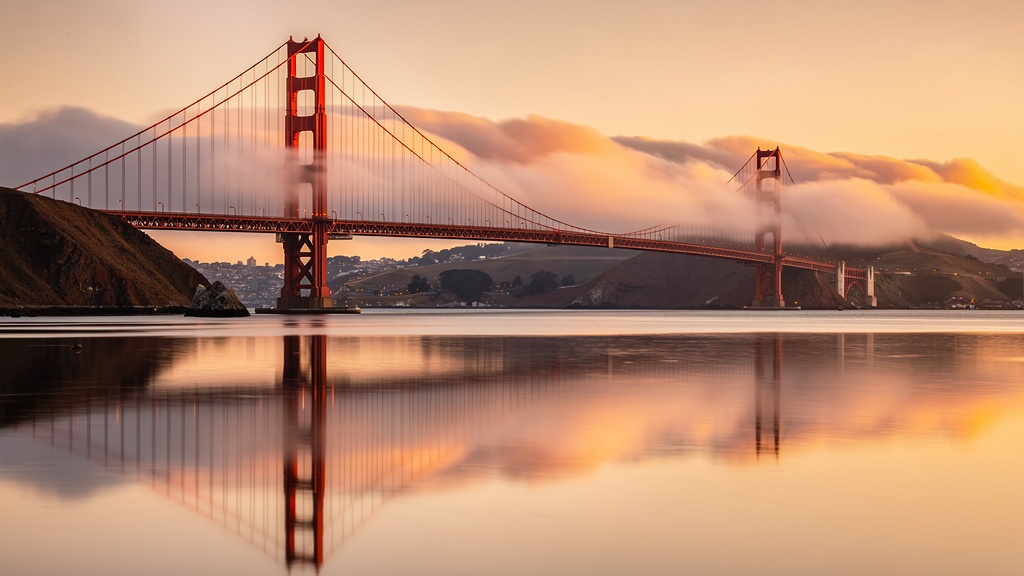
San Francisco occupies the tip of a peninsula between the Pacific Ocean to the west and San Francisco Bay to the east. Its geography — 49 square miles sculpted by tectonic forces into dramatic hills, valleys, and waterfront coves — gives the city its instantly recognizable skyline and creates a thousand different vantage points from which the urban landscape unfolds like a living painting.
Established as a Spanish mission settlement in 1776 and transformed almost overnight by the Gold Rush of 1848–1855, San Francisco grew with frantic energy into the financial and cultural capital of the American West. The great earthquake and fire of 1906 destroyed much of the city, but it was rebuilt with remarkable speed and swagger. The mid-20th century brought the Beat Generation to North Beach, the counterculture revolution to Haight-Ashbury, and the LGBTQ+ rights movement to the Castro — each leaving indelible marks on the city's identity that remain vivid today.
Today's San Francisco is home to approximately 874,000 residents representing virtually every nationality, ethnicity, religion, and cultural tradition on Earth. It is simultaneously a booming tech hub — the northern anchor of Silicon Valley — and a city with one of the nation's most robust arts communities. Its restaurant scene routinely garners more Michelin stars per capita than almost any other American city. Its public transit system, anchored by the famous cable cars, BART heavy rail, and Muni buses, makes it one of the most accessible and walkable cities in the country.
Visitors to San Francisco will quickly discover that the city rewards unhurried exploration. Yes, the Golden Gate Bridge and Alcatraz deserve their places on every itinerary. But the real magic of San Francisco reveals itself in smaller discoveries: a perfect croque-monsieur at a tiny café in the Tenderloin, a fog-drenched morning walk through Golden Gate Park, a conversation with a fisherman at the waterfront before the city wakes up. The city has a gift for surprise that few destinations can match.
The Golden Gate Bridge: An Engineering Marvel
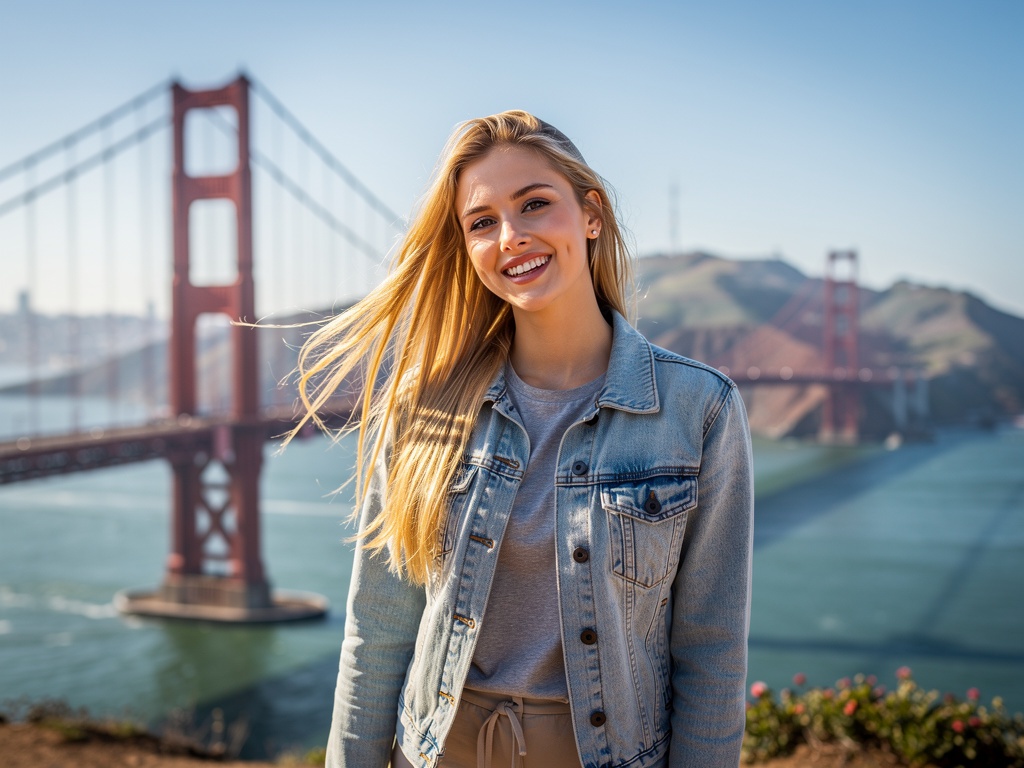
When construction crews completed the Golden Gate Bridge on April 19, 1937, they had accomplished something widely considered to be impossible. The bridge stretches 1.7 miles across the Golden Gate Strait — the tumultuous channel connecting San Francisco Bay to the Pacific Ocean — and remained the longest suspension bridge in the world for 27 years after its completion.
Painted in International Orange (a color chosen over the U.S. Navy's preferred yellow and black because it blended more naturally with the surrounding hills and water), the bridge rises 746 feet above the bay at its tallest towers. The roadway itself hangs 220 feet above the water — high enough to allow most ocean-going vessels to pass beneath.
The bridge's chief engineer, Joseph Strauss, faced extraordinary challenges: powerful tidal currents, frequent fog, fierce winds, and the constant threat of seismic activity. His solution involved an innovative safety net suspended beneath the construction zone — an innovation in workplace safety that saved the lives of 19 workers who fell from the deck during construction.
Today, approximately 10 million people visit the Golden Gate Bridge each year, making it one of the most visited sites in the United States. The bridge is open to pedestrians and cyclists daily, offering views of the bay, the city, Marin County, and the Pacific Ocean that are genuinely unlike anything else in the world.
The bridge looks different at every hour and in every weather condition. A clear sunrise reveals it in sharp relief against a pink and gold sky, with the Marin Headlands rising green and dramatic behind it. By mid-morning, it may be almost completely consumed by the fog — only the towers peeking above the white mist — creating one of the most ethereal natural spectacles in California. At sunset, the International Orange paint glows against the darkening sky in a display of color that photographers worldwide spend their careers trying to capture.
For visitors, the most rewarding approach to the Golden Gate Bridge is on foot. Park at the Golden Gate Bridge Welcome Center on the south side, then walk across the 1.7-mile span. The westerly views open onto the Pacific, while the eastern views encompass the full grandeur of San Francisco Bay. Allow at least 90 minutes for a round-trip crossing, and bring layers — even on warm days, the wind on the bridge can be biting.
🌉 Golden Gate Bridge Visitor Tips
- Hours: Open to pedestrians daily 5:00 AM – 9:00 PM (subject to weather)
- Best Views: Battery Spencer (Marin side) offers spectacular views from above; Crissy Field on the south side for reflections
- Photography: The bridge is most photogenic in early morning fog or at the golden hour before sunset
- Parking: Arrive early or use public transit (bus 28 from downtown) to avoid congestion
- Cycling: Bikes can cross the bridge and connect to Sausalito for a famous round-trip route via ferry back to SF
The Golden Gate Bridge Welcome Center features exhibits on the bridge's construction history, engineering innovations, and cultural significance. It also houses a gift shop and provides information on guided walking tours. The center is free to visit, though parking is charged for private vehicles.
One of San Francisco's most beloved local traditions is the Bridge-to-Bridge run — a popular training route that follows the waterfront from the Bay Bridge through the Embarcadero, along the Marina, through Crissy Field, and up to the Golden Gate Bridge, covering approximately 7 miles of stunning urban scenery. Runners and cyclists share this route daily, particularly on weekend mornings, creating a vibrant outdoor culture that is quintessentially San Franciscan.
Alcatraz Island: The Rock
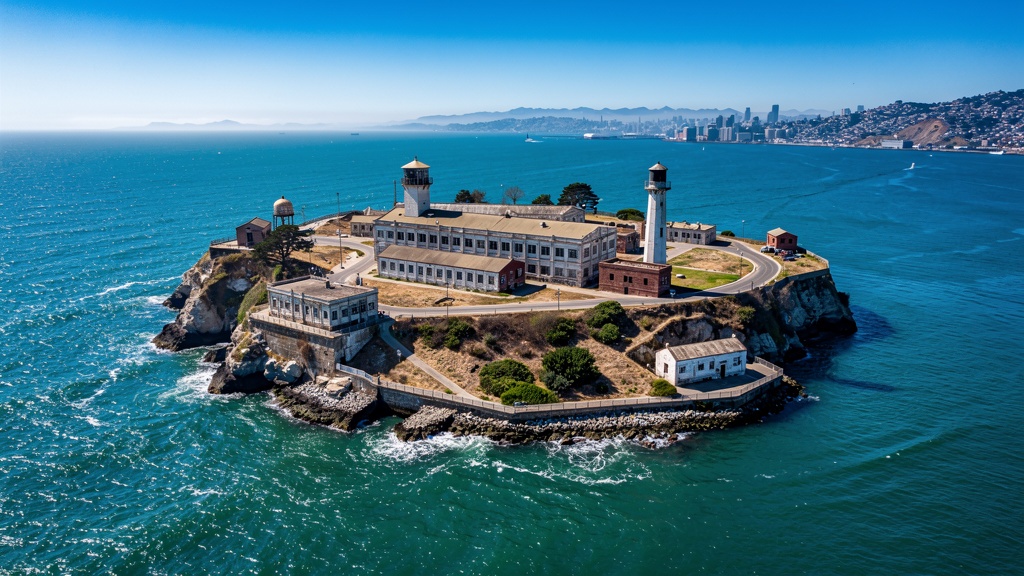
Rising from the cold, shark-patrolled waters of San Francisco Bay approximately 1.25 miles from the city's shore, Alcatraz Island has fascinated and unnerved visitors since before it ever housed a single prisoner. The Ohlone people of the Bay Area knew the island as a place of isolation and avoided it as a habitat of seabirds and sea lions. Early Spanish explorers named it "La Isla de los Alcatraces" — the Island of the Pelicans — when they first mapped San Francisco Bay in 1775.
The United States military recognized the island's strategic value early, establishing a fort there in 1850. The treacherous currents, frigid water temperatures (averaging 55°F), and distance from shore made it a natural fortress. The military used it as a prison as early as the Civil War, housing Confederate sympathizers and court-martialed soldiers in its thick stone walls.
In 1934, the federal government transformed Alcatraz into the most secure federal penitentiary in the United States. Its purpose was to house the most incorrigible criminals in the American prison system — those who had proven themselves escape risks or troublemakers at other federal facilities. Over the next 29 years, Alcatraz held some of the most notorious criminals in American history, including Al Capone, Robert "Birdman" Stroud, and Machine Gun Kelly.
The island's reputation for impregnability was tested but never definitively broken. In its 29-year history as a federal penitentiary, there were 14 escape attempts involving 36 men. Twenty-three were captured, six were shot and killed during the attempts, two drowned, and five — the most famous being Frank Morris and the Anglin brothers in June 1962 — were never definitively accounted for. The FBI officially concluded they drowned, but the case has never been closed.
The federal penitentiary closed in 1963 due to the high operating costs of maintaining an island facility and the deteriorating condition of the buildings. In 1969, the island was occupied by a group of Native American activists for 19 months in a landmark protest that drew national attention to Indigenous rights. Today, evidence of the occupation — including slogans painted on the water tower — remains visible on the island as a permanent part of its history.
Alcatraz is now part of the Golden Gate National Recreation Area and receives approximately 1.4 million visitors annually, making it one of the most popular national park sites in the United States. The renowned Cellhouse Audio Tour, narrated by former inmates and guards, brings the prison's history to vivid life as you walk through the main cell block, the recreation yard, and the dining hall.
⛴ Alcatraz Visitor Essentials
- Tickets: Must be purchased in advance at alcatrazcruises.com — often sells out weeks ahead
- Ferries: Depart from Pier 33 at Fisherman's Wharf; 15-minute crossing
- Time needed: Allow 2–3 hours minimum; the audio tour alone takes about 45 minutes
- Night Tours: Evening tours offer a particularly atmospheric experience; limited availability
- What to bring: Sturdy walking shoes (steep terrain), layers, and a light snack
- Photography: The views of the San Francisco skyline from the island are extraordinary
Beyond the notorious cellhouse, Alcatraz offers surprising natural beauty. The island's gardens, established by soldiers and their families in the 19th century, have been lovingly restored by volunteers and burst with roses, succulents, and flowering plants that thrive in the island's unique microclimate. The ruins of the wardens' house, devastated in a fire during the Native American occupation, are eerily beautiful, their walls shrouded in rose vines. And the shoreline, crowded with nesting seabirds, offers remarkable wildlife viewing — particularly during spring, when the island becomes one of the largest seabird colonies in San Francisco Bay.
Fisherman's Wharf & the Embarcadero
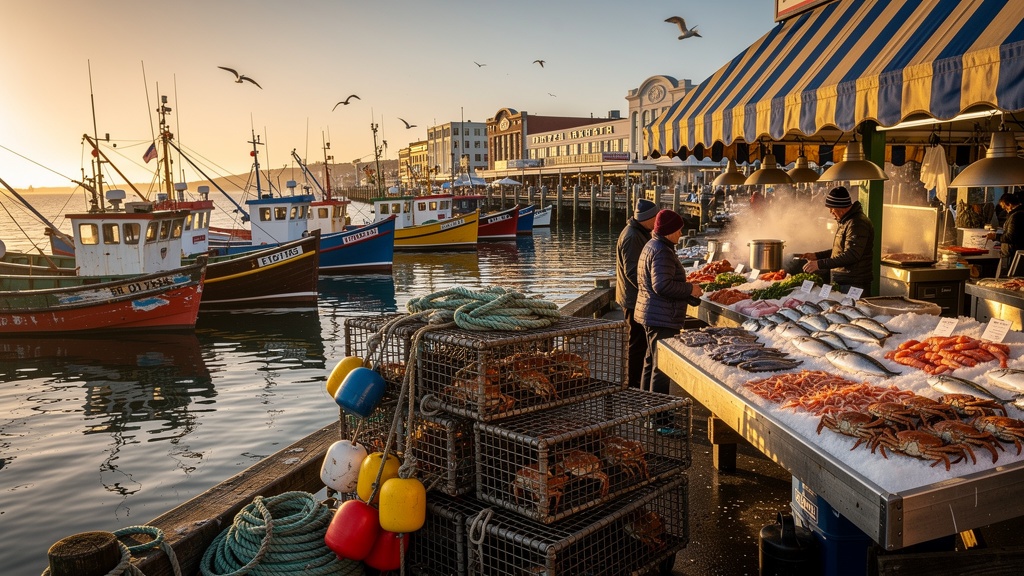
San Francisco's waterfront has been the beating heart of the city since the Gold Rush days, when the bay was filled with hundreds of abandoned ships whose crews had deserted for the gold fields. Fisherman's Wharf — centered on Piers 39 through 45, just north of the Ferry Building — is where that maritime heritage is most viscerally felt today.
The wharf area was originally dominated by Italian immigrants from Genoa and Sicily who arrived in San Francisco in the 1850s and 1860s, establishing the fishing industry that would feed the growing city. Their descendants still operate many of the establishments along the waterfront today, serving the Dungeness crab, clam chowder, and sourdough bread that have become synonymous with San Francisco cuisine.
Pier 39, the most visited section of the wharf, draws millions of visitors annually to its shops, restaurants, street performers, and — perhaps most memorably — its resident colony of California sea lions. These magnificent creatures began hauling out on the pier's K-Dock in January 1990, following the Loma Prieta earthquake, and have never left. At peak season, as many as 1,700 sea lions crowd the floating docks in a spectacle of noise, movement, and chaos that is utterly unique to San Francisco.
The Ferry Building Marketplace, a short walk south along the Embarcadero, is a genuine food lovers' paradise. Housed in a beautifully restored 1898 Beaux-Arts ferry terminal, the marketplace contains some of San Francisco's finest artisan food producers: Acme Bread, the original Cowgirl Creamery, Frog Hollow Farm, and Blue Bottle Coffee among them. On Tuesday, Thursday, and Saturday mornings, the Ferry Building Farmers Market — one of the best in the country — takes over the waterfront promenade outside, drawing chefs and food enthusiasts from across the Bay Area.
Along the Embarcadero itself, a 2.5-mile promenade stretches from the Ferry Building south to AT&T Park, home of the San Francisco Giants baseball team. This walk, passing converted piers housing restaurants, tech companies, and cultural institutions, offers magnificent views across the bay to Oakland and the East Bay hills. Public art installations punctuate the route, and the historic cable car F-line runs the length of the waterfront, providing a charming (and practical) way to travel between Fisherman's Wharf and the Ferry Building.
"To walk along San Francisco's waterfront at dawn, as the fishing boats return and the first light catches the Bay Bridge, is to understand why this city captured the imagination of a continent."
For seafood lovers, Fisherman's Wharf remains essential. The outdoor crab stands along Jefferson Street — where vendors crack and serve whole Dungeness crabs year-round, but particularly during the prime season from November through June — are an institution. Boudin Bakery on Beach Street has been making San Francisco sourdough since 1849, and their flagship location includes a café, bakery tour, and museum. For a more upscale waterfront experience, Scoma's and Alioto's have been serving exceptional fresh seafood since the 1960s, with dining rooms that look directly out onto the bobbing fishing boats of the wharf.
Cable Cars: Riding a Living National Landmark
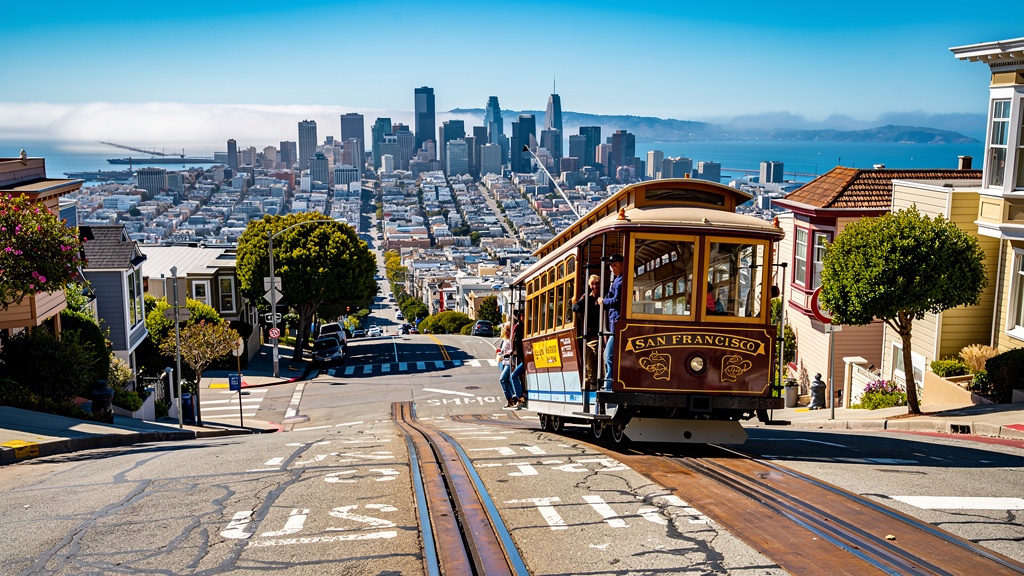
In 1873, a Scottish engineer named Andrew Hallidie watched four horses slip and fall while struggling to haul a streetcar up one of San Francisco's impossibly steep hills, and resolved to find a better way. The solution he devised — a continuous underground cable, moving at a constant speed, to which individual cars could clamp and release as needed — was revolutionary. Today, more than 150 years after Hallidie's first cable car made its inaugural run down Clay Street, this elegant Victorian system still carries passengers up and over the city's famous hills.
San Francisco's cable car network currently comprises three active lines: the Powell-Hyde line, the Powell-Mason line, and the California Street line. The Powell lines are the most famous, running from the turntables at Powell and Market Streets, climbing up and over Nob Hill, and descending to the waterfront at Fisherman's Wharf. The California Street line runs through the heart of the city's historic financial district and Nob Hill neighborhood.
In 1964, the Cable Car system was designated a National Historic Landmark — the only mobile landmark in the country. This status ensures that the system can never be dismantled, preserving a piece of Victorian transportation technology in daily working use. The cars are maintained and operated by Muni (the San Francisco Municipal Railway), which employs a staff of specialized carmen who master the intricate art of working the grip — the mechanical device that clamps onto and releases from the underground cable — in order to control the car on the hills.
Riding a cable car is genuinely one of San Francisco's great pleasures. Standing on the running boards as the car crests a hill and suddenly reveals a panoramic view of the bay is an experience that regularly provokes spontaneous expressions of joy from both first-time visitors and long-time residents. The physical sensation of the cable car — the rattle and clang of the grip mechanism, the slight lurch as it seizes the cable, the wind off the bay as you descend toward the waterfront — is utterly different from any other form of urban transit in America.
🚃 Cable Car Practical Information
- Fare: $8 per boarding (Clipper card or cash); or included in the Muni Day Pass ($23)
- Best Boarding Points: The turntable at Powell and Market (busy but scenic), or board mid-line for shorter waits
- Hours: Approximately 6:00 AM – 12:30 AM daily
- Cable Car Museum: Free entry; watch the actual operating cables in the basement (Washington & Mason Streets)
- Tip: Line up early on weekends; the Powell lines can have 30–45 minute waits in summer
Golden Gate Park: The Green Heart of San Francisco
Stretching three miles from the eastern neighborhoods to the Pacific Ocean, Golden Gate Park is one of the great urban parks of the world — larger than New York's Central Park, and arguably richer in cultural and natural assets. When Frederick Law Olmsted deemed the sand dunes on which it was proposed impractical for park development in the 1860s, William Hammond Hall took on the challenge, and his successor John McLaren spent 53 years transforming the barren dunes into one of America's most extraordinary green spaces.
The park contains three world-class museums: the de Young Museum (fine arts, with a stunning copper-clad building that has oxidized beautifully over time), the California Academy of Sciences (a living museum with a four-story rainforest, an aquarium, and a planetarium under a living roof), and the Japanese Tea Garden — the oldest public Japanese garden in the United States, established in 1894. The combination of art, science, and natural beauty in a single park is rare anywhere in the world.
Beyond the cultural institutions, Golden Gate Park contains extraordinary natural spaces. The Conservatory of Flowers, a spectacular Victorian greenhouse dating from 1878, houses rare tropical plants from around the world. The Rose Garden contains over 10,000 rose plants representing 6,000 varieties. The bison paddock, home to a small herd of American bison since 1899, provides one of the city's most unexpected wildlife encounters. And on foggy evenings, the windmill at the park's western end — one of two restored Dutch windmills that once pumped water to irrigate the park — lends an improbably romantic quality to the western boundary near Ocean Beach.
On Sundays, a significant stretch of John F. Kennedy Drive is closed to cars, transforming into a haven for cyclists, skaters, joggers, and families. Golden Gate Park on a Sunday morning is one of the quintessential San Francisco experiences: a multicultural, multigenerational celebration of outdoor life that reflects the city's best values of inclusivity and community.
Practical Visitor Tips for San Francisco
🌁 Dressing for the Fog
San Francisco's famous fog — affectionately known as "Karl" by locals — can drop temperatures by 15–20°F in minutes. Even in summer, mornings and evenings can be cold and windy, particularly near the ocean and on elevated areas like Twin Peaks and the Marin Headlands. The rule is simple: always carry a layer, no matter how warm the day begins. The classic mistake of tourists is to arrive in shorts and sandals on what looks like a sunny July morning, only to be caught shivering by noon.
🚶 Walking the Hills
San Francisco's hills are genuine: the steepest sections of streets like Filbert, Vallejo, and 22nd Street reach gradients exceeding 30%. Comfortable, rubber-soled shoes are essential. The hills are physically demanding but the views from the top — of the bay, the bridges, the rooftops of the city spreading out below — are among the most spectacular urban vistas anywhere. The 16 Steps at Vulcan Street in the Castro and the wooden Filbert Steps on Telegraph Hill are local favorites for hill-walking routes.
🍽 Dining on a Budget
San Francisco is an expensive food city, but exceptional affordable options exist. The Mission District's taquerias — La Taqueria and El Farolito among them — serve some of the finest burritos in the world for well under $15. The Richmond and Sunset districts offer extraordinary cheap Asian food (dim sum, pho, ramen, Ethiopian injera). The Ferry Building Farmers Market is ideal for picnic ingredients. Lunch at high-end restaurants often offers the same quality as dinner at significantly lower prices.
🚗 Parking & Transit
Driving in San Francisco is challenging and expensive. Parking is scarce, meter enforcement is strict (the city has some of the most aggressive parking enforcement in the country), and the hills require understanding of the city's one-way street system. Public transit is strongly recommended. Muni's network covers the entire city; BART connects SF to the East Bay, South Bay, and airports. For visitors, the CityPASS and SF CityPASS include transit passes and museum admissions at significant savings.
The Best Time to Visit San Francisco
Contrary to popular belief, the best time to visit San Francisco is not summer. September and October are widely considered San Francisco's finest months by locals: the fog retreats, temperatures warm to comfortable highs of 65–70°F, the summer crowds thin, and hotel rates drop from their peak season levels. The combination of warm, clear days, brilliant colors at the bay and in the parks, and the return of a more relaxed local atmosphere makes early fall the golden season for SF visitors.
Spring, from March through May, brings dramatic floral blooms to Golden Gate Park and the Presidio, wildflowers to the Marin Headlands, and whale watching opportunities along the coast. Temperatures are mild and variable, and afternoon fog can appear suddenly, so layers are essential. This period also catches the cherry blossom season in the Japanese Tea Garden, typically peaking in late March.
Summer in San Francisco is a study in microclimates. While the rest of California bakes, SF is often cool, gray, and foggy — particularly in the morning and evening. This is, of course, exactly what draws many visitors: the drama of the fog rolling over the hills and bridges is genuinely spectacular. July 4th can be downright chilly. But the fog typically burns off by mid-morning in the eastern neighborhoods and downtown, and days are never unpleasantly hot. The city's many summer festivals — from Outside Lands Music Festival to SF Pride — provide compelling reasons to visit despite the fog.
Winter (December through February) is San Francisco's rainy season, though rainfall is concentrated in brief but intense storms rather than persistent gray drizzle. Clear winter days between storms can be extraordinarily beautiful, with snow-capped Sierra peaks visible from Twin Peaks or the Marin Headlands, and the bay sparkling under clean winter light. Crowds are minimal, hotel rates are at their lowest, and restaurants have their most creative seasonal menus.
Accommodation in San Francisco: Where to Stay
San Francisco's accommodation landscape ranges from ultra-luxury hotels occupying historic buildings on Nob Hill to lively boutique hostels in the Mission District, with a wide spectrum of mid-range hotels and inns in between. The key to choosing accommodation in SF is location, as the city's neighborhoods are strikingly different from one another and the distance between them, while physically short, can be significant in terms of character.
Union Square & Downtown is the most central location for first-time visitors, placing you within easy walking distance of the cable car turntable, Yerba Buena Gardens cultural district, and BART access to all points in the Bay Area. Marquee properties here include the historic Westin St. Francis (established 1904, fronting Union Square), the St. Regis San Francisco (ultra-luxury with an extraordinary contemporary art collection), and the Proper Hotel (a beautifully designed boutique property in a 1926 Flatiron building).
Nob Hill is the city's grand historic hotel district, home to the legendary Fairmont San Francisco (where the UN Charter was drafted in 1945), the Mark Hopkins InterContinental (with its famous Top of the Mark cocktail lounge), and the Huntington Hotel (a family-owned grande dame preferred by visiting heads of state). Staying on Nob Hill places you above the cable car lines, with magnificent bay views and easy access to Chinatown and North Beach.
The Embarcadero & North Beach offer convenient access to Fisherman's Wharf, Alcatraz ferries, and the Ferry Building, and sit in the city's most historic neighborhoods. The Hotel Vitale on the Embarcadero (with bay-facing rooms) and the Columbus Motor Inn near North Beach (a modest but well-located option) represent the range available here.
For travelers seeking the most authentic neighborhood experience, the Mission District and the Castro offer mid-range boutique hotels and vacation rentals surrounded by San Francisco's most vibrant dining and nightlife scenes. The Parker Guest House in the Castro is a Victorian mansion converted into an elegant gay-friendly bed and breakfast with a devoted following.