California Wine: A World-Class Legacy
The date November 25, 1976, marks a watershed moment in the history of wine. In a Paris tasting organized by British wine merchant Steven Spurrier, a panel of the most respected French wine critics blind-tasted both French and California wines — and selected a California Cabernet Sauvignon (Stag's Leap Wine Cellars 1973) and a California Chardonnay (Chateau Montelena 1973) as the finest in their respective categories. France — and the world — was stunned. The event, immortalized as the "Judgment of Paris," announced California's arrival as a global wine power and transformed the American wine industry overnight.
Half a century later, California is the fourth-largest wine producer in the world, trailing only France, Italy, and Spain, and producing approximately 85 percent of all American wine. The state's wine regions span a remarkable range of climates and terroirs, from the cool marine-influenced valleys of Sonoma and Santa Barbara to the sunbaked hillsides of Napa and the limestone-rich soils of Paso Robles. This geographic diversity produces wines of staggering range: gossamer Pinot Noirs from the Sonoma Coast, massively structured Cabernets from Napa's Rutherford Bench, aromatic Chardonnays from Santa Barbara's Sta. Rita Hills, and spicy Zinfandels from the old-vine vineyards of Dry Creek Valley.
But wine country travel is about much more than wine. California's wine regions have developed some of the finest cuisine in the United States, driven by the same farm-to-table ethos that makes the vineyards themselves so compelling. Michelin-starred restaurants, artisan cheese producers, olive oil estates, lavender farms, and luxurious spa resorts are all woven into the wine country experience. A weekend in Napa or Sonoma is as much about eating, soaking in a tub overlooking the vines, and cycling through golden autumn afternoons as it is about accumulating tasting notes.
This guide covers California's four principal wine regions — Napa Valley, Sonoma County, Paso Robles, and Santa Barbara — in sufficient depth to help you plan a wine country visit whether you're a passionate enthusiast or a curious first-timer who simply enjoys a well-made glass with a view.
Napa Valley: The Crown Jewel of American Wine
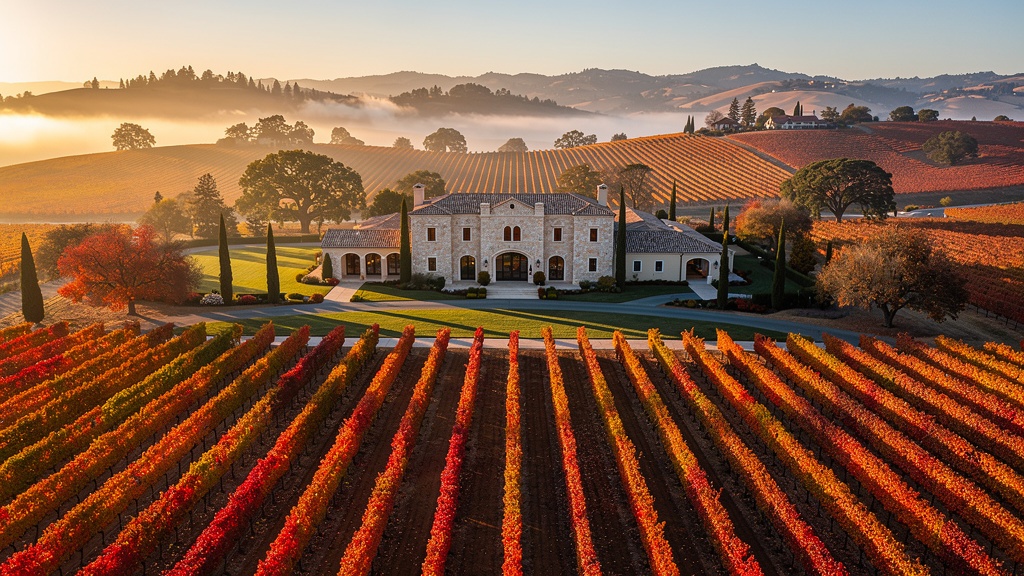
Napa Valley is simultaneously California's most famous and most misunderstood wine region. Famous because the names of its wineries — Opus One, Screaming Eagle, Harlan Estate, Stag's Leap, Beringer — are synonymous with American winemaking excellence. Misunderstood because many visitors arrive expecting a rustic agricultural backwater and discover instead a landscape of extraordinary natural beauty, world-class gastronomy, and architectural ambition that rivals anything in the Loire Valley or Bordeaux.
Geography and Terroir
Napa Valley is a narrow valley — roughly 30 miles long and 5 miles wide at its broadest — oriented on a roughly north-south axis between the Mayacamas Mountains to the west (forming the border with Sonoma County) and the Vaca Range to the east. The Napa River flows south through the valley floor, and the famous Highway 29 and the Silverado Trail run parallel to each other on the valley's western and eastern edges respectively, connecting the wine towns from Napa city in the south to Calistoga in the north.
Napa's 16 officially recognized sub-appellations (American Viticultural Areas, or AVAs) each possess distinct terroir that produces wines of different character. The most prestigious include:
- Rutherford: Famous for its "Rutherford dust" — an earthy, tobacco-like complexity in its Cabernet Sauvignons said to derive from well-drained benchland soils. Home to Beaulieu Vineyard (the legendary Georges de Latour Private Reserve), Inglenook, and Rubicon Estate.
- Oakville: Perhaps Napa's most prized vineyard land. Grapes here achieve the ideal balance of power and elegance. Home to Opus One, Far Niente, and the legendary To Kalon Vineyard.
- Stags Leap District: Produces Cabernets noted for their plush texture and relative finesse compared to other Napa sub-regions. The 1973 Stag's Leap Wine Cellars that won the Judgment of Paris came from here.
- Howell Mountain: An elevated sub-appellation above the valley fog line at 1,400–2,200 feet. Produces intensely structured, ageworthy Cabs from volcanic soils and smaller berries concentrated by mountain stress.
- Mount Veeder: Another mountain AVA on the Mayacamas crest. Cooler temperatures produce more herbaceous, structured Cabs with excellent aging potential.
Must-Visit Napa Wineries
Domaine Carneros sits at the valley's southern end on a Carneros hillside, its French château architecture visible for miles. Specializing in sparkling wines made in the traditional Champagne method, it offers seated tastings on a terrace overlooking the vineyards — arguably the most Instagram-perfect winery setting in California.
Beringer Vineyards in St. Helena is the oldest continually operating winery in Napa Valley, having maintained production through Prohibition by selling sacramental wines. Its Rhine House — a Victorian mansion built in 1883 — hosts tasting rooms of historic grandeur. The Reserve tasting is particularly rewarding.
Castello di Amorosa near Calistoga is a genuine 13th-century-style Tuscan castle built over 14 years by owner Dario Sattui — complete with drawbridge, dungeon, and a 95-room interior. It produces Italian-varietal wines that take on added charm when sipped in an actual medieval castle.
Opus One in Oakville, the legendary collaboration between Robert Mondavi and Baron Philippe de Rothschild (of Château Mouton Rothschild), produces a single Bordeaux-blend wine considered one of America's finest. The modernist winery building is architecturally significant; the tasting is expensive but memorable.
Schramsberg Vineyards in Calistoga operates California's oldest producing sparkling wine caves, carved by Chinese laborers in the 1870s. A guided cave tour followed by a sparkling wine tasting is one of the most enjoyable winery experiences in Napa Valley.
Hot Air Ballooning Over Napa Valley
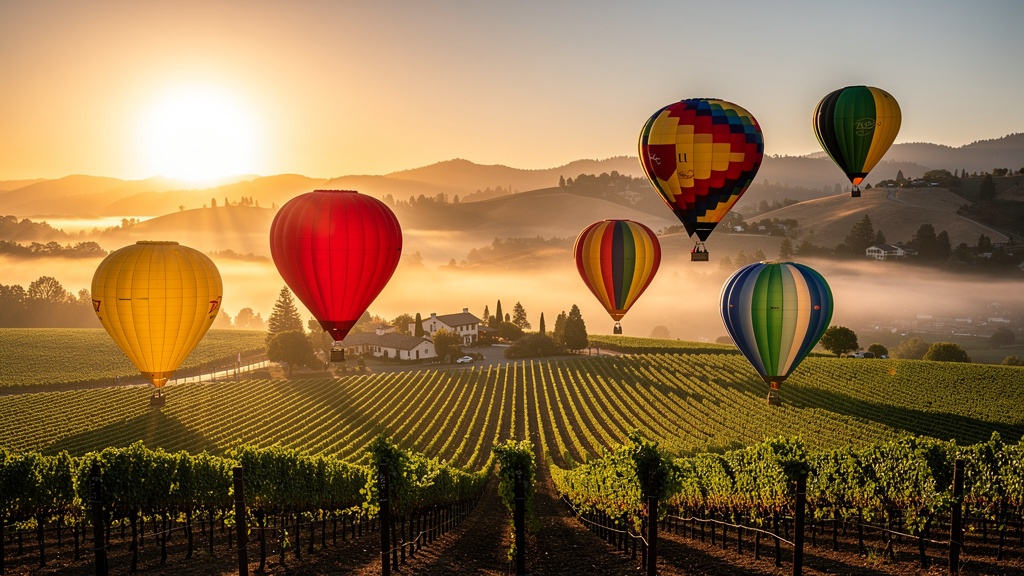
One of the most memorable experiences available in any American wine region is a dawn hot air balloon flight over Napa Valley. Several operators — Napa Valley Balloons, Balloons Above the Valley, and Domaine Carneros Balloon Company — launch at sunrise, when the valley is still shrouded in morning mist and the light is warm and horizontal. From the basket, the geometric patchwork of vineyard blocks, the silver thread of the Napa River, and the blue line of the Mayacamas Mountains create a landscape of almost painterly beauty. Flights typically last an hour and conclude with a Champagne toast in a meadow.
Napa Valley Dining
Napa Valley supports a restaurant scene of extraordinary depth for a region of its modest size. The French Laundry in Yountville, Thomas Keller's legendary three-Michelin-star restaurant, has maintained its position as one of the finest restaurants in the world for over three decades. Reservations require planning months in advance and generally sell out within minutes of the booking window opening on Tock. Keller's more casual (but still exceptional) Bouchon Bistro next door is considerably easier to book and offers pitch-perfect French bistro cooking.
Yountville itself — a tiny town that contains a concentration of world-class restaurants scarcely believable for a community of 3,000 — also offers Bottega (Michael Chiarello's Italian-California cuisine), Redd, and the beautifully designed Bistro Jeanty. St. Helena's Farmstead at Long Meadow Ranch serves house-raised beef, lamb, and produce in a converted barn setting that perfectly captures the wine country farm-to-table ideal. Calistoga's Solbar at Solage resort offers spa cuisine in a setting that somehow manages to be both elegant and genuinely relaxing.
Napa Valley Towns & Villages
Napa City
The city of Napa, at the valley's southern gateway, has been transformed over the past two decades from a slightly forlorn agricultural service town into one of California's most appealing small cities. The revitalized Oxbow Public Market — a magnificent food hall on the Napa River waterfront — brings together artisan food producers, wine merchants, a raw oyster bar, a full-service butcher, and Cal-inspired restaurants under a single industrial-chic roof. It is the ideal first stop for any Napa Valley visit, offering a condensed survey of the region's food and wine culture. The adjacent First Street corridor has attracted boutique hotels, farm-to-table restaurants, and wine bars that make downtown Napa a worthy destination in its own right.
Yountville
Yountville's concentration of Michelin stars per capita is arguably unmatched anywhere in the world. Beyond The French Laundry, the village offers wine bars, gallery walks, public art installations, and the V Marketplace — a Victorian stone winery converted to artisan shops and tasting rooms. The Napa Valley Museum examines the valley's ecology and wine history through thoughtful exhibitions. Yountville is also the base for many hot air balloon operators and is walkably connected to several prestigious wineries including Domaine Chandon, a French Champagne house (Moët & Chandon) whose Napa outpost offers sparkling wine alongside beautiful gardens.
St. Helena
Considered the valley's most prestigious address — Napa Valley's equivalent of Beverly Hills — St. Helena sits at the heart of the most coveted vineyard land and maintains a Main Street of elegant boutiques, tasting rooms, and superb restaurants. The Culinary Institute of America at Greystone, housed in a dramatic 1889 stone winery, offers public cooking demonstrations, a restaurant, and culinary shops. The Napa Valley Wine Library, maintained by a dedicated volunteer organization, holds an archive of historic California wine labels and literature open to the public.
Calistoga
Calistoga, at the northern end of the valley, occupies a different register from its neighbors — more relaxed, more geologically dramatic, and more associated with its legendary hot springs than with fine wine (though the wine is excellent). The town sits in a geothermal hot spot where natural mineral springs bubble to the surface, and its historic bathhouses offer volcanic mud baths, mineral water soaks, and massages that have attracted visitors since the 1860s. The Calistoga Spa Hot Springs and the Indian Springs Resort (which offers mud baths in the original 1913 bathhouse) are institutions. Old Faithful Geyser of California — one of only three "faithful" geysers in the world — erupts approximately every 30 minutes in a meadow north of town and costs just a few dollars to watch.
Sonoma County: Napa's More Relaxed, Diverse Neighbour
Where Napa Valley is polished, focused, and unabashedly luxurious, Sonoma County is sprawling, diverse, and — despite the presence of many world-class wineries — fundamentally more relaxed. It is a place where you might find yourself at a wooden picnic table in a redwood grove drinking a remarkable Pinot Noir from a winemaker who also raises heritage pigs and bakes bread in a wood-fired oven. Sonoma's 60+ miles of Pacific coastline, its ancient redwood forests, its dairy farms and oyster beds, and its seventeen distinct wine regions make it one of the most multifaceted wine counties anywhere in the world.
Sonoma Valley and the Sonoma Coast AVA
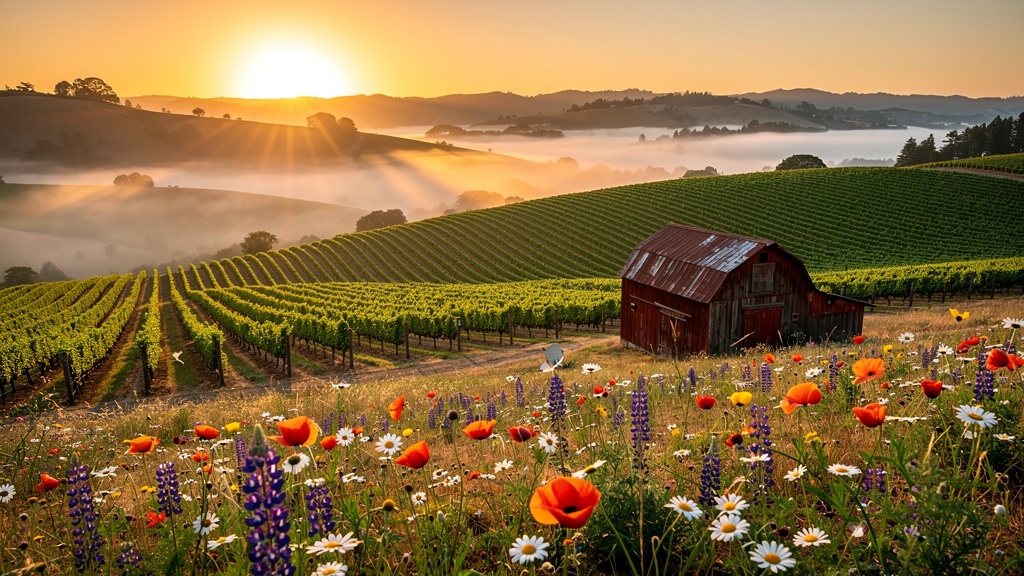
The Sonoma Valley — often called the "Valley of the Moon" after Jack London's novel — is the most accessible part of Sonoma County from the Bay Area, running north from the San Pablo Bay to the Mayacamas Mountains that divide it from Napa. The town of Sonoma, at the valley's southern end, is anchored by California's largest adobe structure (Sonoma Barracks, from the 1830s) and its eight-acre central plaza — the largest plaza in California and the site of the 1846 Bear Flag Revolt, when American settlers raised the Bear Flag that would become the California state flag.
The Sonoma Coast AVA, stretching 60 miles along the Pacific coastline, is one of California's coolest wine regions, its foggy, wind-blown conditions producing Pinot Noirs and Chardonnays of remarkable elegance and acidity. Wineries such as Hirsch Vineyards, Littorai, and Fort Ross-Seaview produce wines of cult status that are sought by collectors internationally. The coast itself — accessible via Highway 1 or the Bohemian Highway from Occidental — is wild, cold, and breathtakingly beautiful.
Russian River Valley
The Russian River Valley AVA, carved by the Russian River west of Santa Rosa, is California's most acclaimed Pinot Noir region and home to some of its most sought-after wineries. Williams Selyem, Rochioli, Gary Farrell, and Iron Horse are among the producers whose Russian River Pinots have earned national and international acclaim. The town of Guerneville, a funky resort community on the river, offers charming inns, excellent farm-to-table restaurants, and river kayaking in summer. The nearby Armstrong Redwoods State Natural Reserve protects ancient coast redwoods within 10 miles of the wine country — a remarkable juxtaposition of terroirs.
Dry Creek Valley and Alexander Valley
Dry Creek Valley, a narrow canyon north of Healdsburg, is California's spiritual home of Zinfandel — the grape that arguably produced America's first great red wine. Old-vine Zin vineyards here date to the 1880s, tended by Italian immigrant families who planted them and whose descendants still farm them today. Ridge Vineyards' Geyserville and Dry Creek labels, Ravenswood, and A. Rafanelli produce from these ancient vines wines of extraordinary depth and generosity. Alexander Valley, Dry Creek's neighbor to the east, produces richer, more Napa-like Cabernets and Merlots in a broader, warmer corridor. The historic Simi Winery, founded in 1876, and the impressive Jordan Winery (whose chateau is modeled on a Bordeaux property) anchor the region.
Sonoma Towns & Wine Trails
Healdsburg: Sonoma's Most Sophisticated Town
Healdsburg has emerged over the past decade as perhaps the most compelling wine-country destination in California for food-and-wine enthusiasts. Centered on a shaded Victorian plaza ringed with wine bars, world-class restaurants, and boutique hotels, Healdsburg sits at the intersection of three major wine regions — Dry Creek Valley, Alexander Valley, and Russian River Valley — making it an ideal base for exploring all three. Barndiva's farm-to-table cuisine in its lush garden is widely considered one of California's finest dining experiences outside San Francisco. The Single Thread Farms restaurant and inn (three Michelin stars) brings a Japanese-influenced precision to Sonoma County ingredients in a setting of extraordinary refinement.
Sonoma Town
The town of Sonoma rewards a full day of leisurely exploration. The Sonoma State Historic Park encompasses the mission, barracks, and General Mariano Vallejo's home — collectively a remarkably intact window into early California history. The Sonoma Cheese Factory produces handmade jack and cheddar following recipes dating to 1931. The plaza's many wine bars — particularly Tasca Tasca, Steiner's Tavern, and the excellent Girl and the Fig restaurant — offer comfortable bases for afternoon tastings of small-production local wines.
Guerneville & the Russian River
Guerneville, 15 miles west of Healdsburg on the Russian River, offers a distinctive wine-country experience defined more by the river than the vines — though the vines are superb. Summer weekends bring kayakers, tubers, and swimmers to the river's calm green pools, while the surrounding second-growth redwoods (Armstrong Redwoods is five minutes away) provide shade and cool. The town's restaurant scene has improved dramatically in recent years: Boon Eat + Drink, Big Bottom Market, and the Seaside Metal Oyster Bar all serve excellent local ingredients with the easy confidence of establishments that know they have the best raw materials in the state.
Paso Robles: California's Rising Wine Star
Paso Robles, located in San Luis Obispo County midway between San Francisco and Los Angeles on US-101, has transformed in a single generation from an agricultural backwater to one of California's most exciting wine regions. The region's enormous diurnal temperature range — summer days regularly reach 100°F while nights cool to 50°F — concentrates fruit sugars while preserving the natural acidity that gives well-made Paso wines their structure and freshness.
Paso's signature variety is Cabernet Sauvignon, produced in a distinctively Paso style — darker-fruited, more structured, and often higher in alcohol than Napa counterparts, yet with a rustic, Western character that appeals to consumers who find Napa Cabs too polished. The region's Zinfandel, Petite Sirah, and Rhône varietals (Syrah, Grenache, Mourvèdre, Viognier) are equally impressive. Tablas Creek Vineyard, a joint venture between the Perrin family of Château de Beaucastel (Châteauneuf-du-Pape) and importer Robert Haas, has pioneered Rhône varietals in Paso with spectacular results; their estate Côtes de Tablas and individual varietal wines set the regional benchmark.
The town of Paso Robles itself is unpretentious and walkable, with a pleasant downtown square, a growing number of excellent farm-to-table restaurants, and wine tasting rooms that outnumber coffee shops. Justin Vineyards and Winery, whose Isosceles (a Bordeaux-blend) is one of California's most consistently decorated red wines, offers estate accommodation in the form of JUST Inn — four luxurious suites in a farmhouse overlooking the estate vineyards.
The Paso Robles Wine Festival in mid-May is one of California's most celebrated wine events, drawing thousands of visitors for a weekend of barrel tastings, winemaker dinners, and outdoor pavilion pours. The Harvest Wine Weekend in October, held during the crush, allows visitors to walk working vineyards and participate in hands-on harvest activities. Both events sell out early; accommodation for 50 miles around Paso books up months in advance.
Santa Barbara Wine Region: Hollywood Meets the Vineyard
The Santa Barbara wine region — centered on the Santa Ynez Valley and the Sta. Rita Hills AVA west of the city — was largely unknown outside California until the 2004 film Sideways sent a generation of wine drinkers searching for Pinot Noir. The film was not wrong about the wine: Santa Barbara's Pinot Noirs, Chardonnays, and Syrahs are world-class, and the region's proximity to Los Angeles and San Francisco makes it one of California's most visited wine destinations.
The Sta. Rita Hills AVA is the region's most prestigious sub-appellation, a narrow east-west oriented valley that funnels cool Pacific air and morning fog directly into the vineyards. Brewer-Clifton, Melville, Sanford, and Sea Smoke are among the producers whose Pinot Noirs and Chardonnays from this AVA have earned international reputations. The diurnal temperature swings here can exceed 50°F, producing wines of extraordinary aromatic complexity and natural acidity.
The Santa Ynez Valley, east of Sta. Rita Hills and somewhat warmer, supports a wider range of varieties. The towns of Solvang (a Danish-themed village that is one of California's most visited tourist destinations), Los Olivos (a tiny crossroads with an outsized concentration of fine tasting rooms), and Santa Ynez itself all offer tasting room experiences. The Foxen Canyon Wine Trail connects a string of excellent producers along a back road north of Santa Ynez.
The Happy Canyon of Santa Barbara AVA, in the warmer eastern reaches of the valley, produces excellent Cabernet Sauvignon and Bordeaux blends from a handful of boutique producers. Sunstone Vineyard and Winery, an organic estate whose Tuscan stone buildings are among the most beautiful in any California wine region, exemplifies the quality possible here.
Harvest Season & Wine Country Events
Harvest season — generally mid-August through October, varying by variety and location — is the most dynamic and beautiful time to visit California wine country. The vineyards turn gold, red, and russet; the air carries the fermenting sweetness of the crush; and wineries open their doors for events, harvest dinners, and barrel tastings that are simply not available at any other time of year.
Key Annual Events
- Napa Valley Wine Auction (June): The annual Fund4Education Auction Napa Valley is a three-day charity event — the Meadowood auction, the barrel auction, and the live auction — that raises millions for local educational charities and attracts wealthy wine collectors worldwide. Entry is by invitation only, but the associated barrel tasting and winemaker dinners are open to a wider public.
- Sonoma Wine Country Weekend (August): A three-day event featuring winemaker dinners, a Grand Tasting on the Sonoma Plaza, and winery open houses across the county. Proceeds benefit local charities. One of the best-value wine country events in California.
- Napa Valley Film Festival (November): A five-day festival screening independent films in venues across the valley — including winery cellars and outdoor screens — with screenings accompanied by wine tastings and filmmaker Q&As. A wonderfully unconventional film festival experience.
- Paso Robles Harvest Wine Weekend (October): Two days of hands-on harvest participation, cellar tours, and outdoor tastings across the Paso Robles wine region. The most accessible harvest event in California for visitors who want a genuine working-winery experience.
How to Taste Wine Like an Expert
Wine tasting is both a skill and a pleasure, and the two are not always in proportion. Here is a framework that will help you get more from every glass in any tasting room in California:
The Four Steps of Tasting
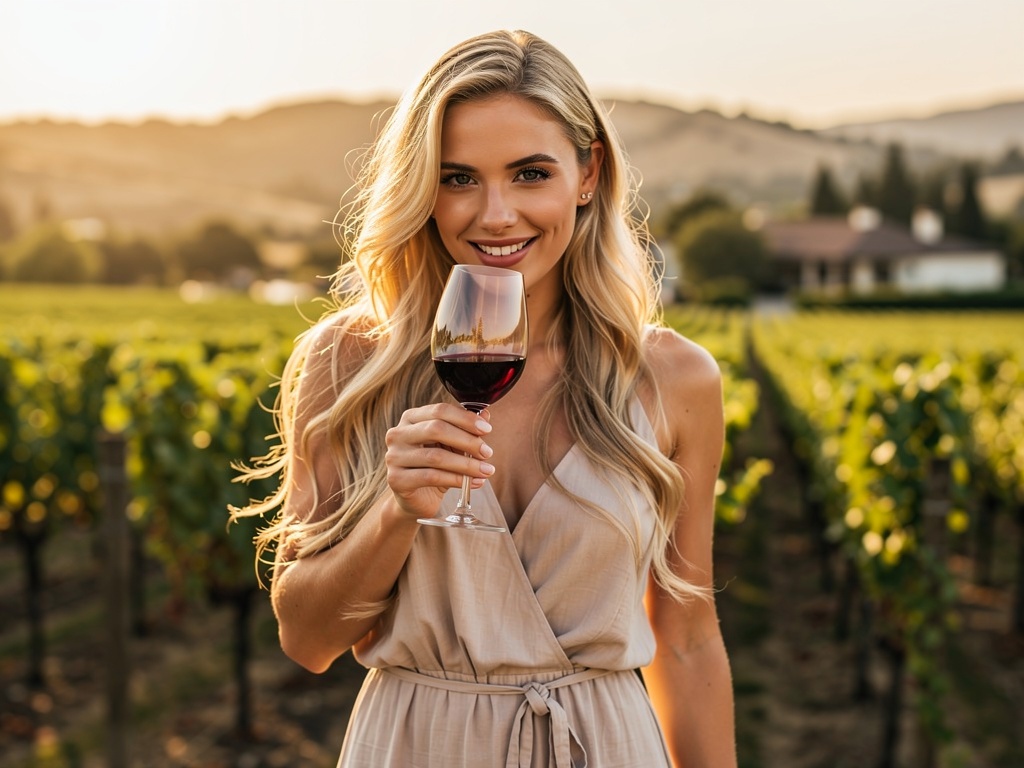
1. Look: Hold the glass by the stem (to avoid warming the wine with your hand) and tilt it slightly against a white background. Examine the colour and clarity. A deep ruby red suggests a full-bodied red; a brick or orange rim on an aged red indicates evolution. A pale yellow Chardonnay is likely lightly oaked or unoaked; a deeper gold suggests barrel aging or a warmer growing year.
2. Smell: Swirl the glass to release aromatic compounds, then bring your nose to the rim and take two short sniffs followed by one deep breath. Identify the broadest category first (fruity? floral? earthy? oaky?) then narrow down. California Cabernets often show blackcurrant, cedar, and graphite. Napa Chardonnays show ripe apple, vanilla, and toasted oak. Russian River Pinots show strawberry, cherry, and forest floor.
3. Taste: Take a small sip and let the wine rest on your palate for a moment before swallowing. Note the primary flavours, the structure (tannin in reds, acidity in whites), and the finish (how long does the flavour linger after swallowing?). Great wines have long finishes — 30 seconds or more in the finest examples.
4. Think: Does the wine achieve balance between its components? Does it have complexity (does it change and reveal new nuances as it sits in the glass)? Would you buy it, and at what price? Writing brief notes on your phone prevents the inevitable confusion of having tasted 20 wines across three wineries by mid-afternoon.
Tasting Room Etiquette
- Book appointments in advance for premium wineries — many Napa estates now require them, particularly for reserve and library tastings.
- It is perfectly acceptable to spit — tasting rooms provide receptacles for this purpose, and spitting is what allows serious tasters to maintain their faculties through a full day of visits.
- Don't feel obligated to purchase wine; equally, if you love a wine, buying even one bottle from a small producer is genuinely appreciated.
- Ask questions — winery staff are almost always knowledgeable, passionate, and genuinely happy to explain the wine, the vintage, or the vineyard in as much detail as you'd like.
- The Wine Road app (covering Sonoma County) and Napa Valley's Experience Napa app aggregate winery information, hours, and booking links — download before your visit.
Planning Your California Wine Country Visit
When to Visit
🌷 Spring (Mar–May)
Mustard flowers carpet vineyard floors in February–March — Napa's Mustard Festival celebrates this display. Smaller crowds, competitive hotel rates, and the vines budding with the year's promise.
☀️ Summer (Jun–Aug)
Peak tourist season — hotels full, tasting rooms busy, traffic heavy on Highway 29. But the vineyards are lush and green, outdoor dining is perfect, and the valley has an infectious energy.
🍂 Harvest (Sep–Oct)
The finest time to visit. Grape-picking crews work dawn to dusk, the vines flame in autumn colours, and every winery hosts harvest dinners and barrel tastings. Book everything 3–6 months ahead.
❄️ Winter (Nov–Feb)
The vines are dormant, the crowds are gone, and hotel rates drop by 40–60%. Truffle and mushroom season begins. Winery release events for new vintages run through January–February.
Getting Around
The most important logistical reality of wine country travel is that you should not plan to drive yourself from tasting room to tasting room all day. A designated driver, a hired car service, or a guided tour is not optional — it's the only responsible approach, and California law enforcement is appropriately stringent in wine country areas. Options include:
- Uber/Lyft: Available in Napa and Sonoma towns and most surrounding areas, though waits can be long during peak periods.
- Wine country car services: Valley Coach, Platypus Wine Tours, and dozens of local operators offer half-day and full-day guided winery tours with transport included. Prices range from $60–$150 per person.
- Cycling: The Silverado Trail and many Sonoma county roads are excellent for cycling. Wine-country cycling tours, with a support van to carry purchases, are a memorable way to visit vineyards between Yountville and St. Helena.
- Napa Valley Wine Train: A restored Pullman railcar that makes a 36-mile round trip through the valley, serving meals in an elegant dining car alongside Napa Valley wines. More tourist attraction than efficient transport, but delightfully atmospheric.
Where to Stay
Napa Valley: Meadowood Napa Valley (St. Helena, rebuilt after the 2020 Glass Fire) is the valley's most storied resort; Auberge du Soleil above Rutherford offers Provençal-style luxury with panoramic valley views; Carneros Resort and Spa at the southern end is beautifully designed with individual bungalows, pools, and a farm-to-table restaurant. For mid-range accommodation, Calistoga's collection of spa hotels and Victorian inns offers excellent value.
Sonoma: MacArthur Place in Sonoma town occupies a beautiful garden property with cottages and a superb restaurant. The Duchamp in Healdsburg is a unique collection of individual artist-designed bungalows. Farmhouse Inn in Forestville, a Michelin-starred restaurant with inn rooms, is the ultimate splurge in the Russian River Valley.
Whatever your budget or taste in accommodation, booking at least 2–3 months ahead for weekends throughout the year and 4–6 months ahead for harvest weekends is strongly advised. California wine country is one of the most visited destinations in the United States, and the inventory of quality rooms is finite.